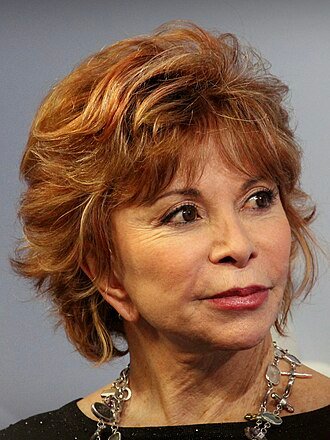
 AuthorIsabel Allendeb. 1942
The House of the Spirits is the first novel by the Chilean writer Isabel Allende. It was turned down by several Spanish-language publishers before being released in Barcelona in 1982 by Plaza & Janés. Its success was immediate: it became an international bestseller, won wide critical acclaim, and established Allende as one of the most influential voices in Spanish-language literature. That same year it was named the best novel of the year in Chile, and the author received her country's Panorama Literario award. Today it has been translated into more than twenty languages.
The book follows the Trueba family across four generations, from the early twentieth century to the 1970s, and traces in parallel the political, social and economic upheavals of Chile. The country is never named explicitly, and neither are certain figures, such as the presidential candidate or the poet, yet their profiles clearly echo real historical personalities. The story is told mainly from the perspective of two protagonists, the patriarch Esteban and his granddaughter Alba, alongside an omniscient narrator who observes events. Its style draws on magical realism, most visibly in Clara's supernatural gifts, and openly acknowledges its debt to Gabriel García Márquez's One Hundred Years of Solitude.
The plot opens with the del Valle sisters. Clara, the youngest, has clairvoyant powers and keeps a detailed diary of her life. Her elder sister Rosa the Beautiful dies poisoned by mistake, since the poison was meant for their father, a candidate for the Senate. Her fiancé, Esteban Trueba, a poor miner, then devotes himself to rebuilding the family estate, Las Tres Marías, and to building a power founded on authority and fear. Years later he marries Clara, and they have three children: Blanca, Jaime and Nicolás. Yet Esteban's violent temper and his abuses, both toward the women working on the estate and within his own household, leave a deep wound on the family.
The novel places class conflict and the country's growing political polarization at its center. The love between Blanca and Pedro Tercero, the son of the foreman, stands for the clash between the traditional order and revolutionary ideas. In the end, the military coup that overthrows the socialist government unleashes brutal repression that reaches the Trueba family itself. Alba, the granddaughter, experiences the regime's violence firsthand and, having survived it, finds the notebooks kept by her grandmother Clara and resolves to write the history of her lineage. That gesture gives rise to the novel itself, presented as an act of memory against forgetting.
Themes
Other works by Isabel Allende
- Zorro 2005
- A Long Petal of the Sea 2019
Original Filopedia text based on Wikipedia (es) and Wikipedia (en) and Wikidata.