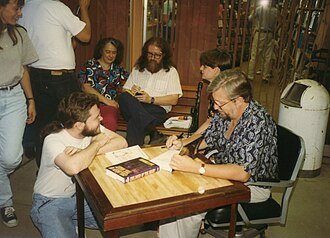
 AuthorDan Simmons1948–2026
Hyperion is a science fiction novel by American author Dan Simmons, published in 1989, and the first book of the Hyperion Cantos. It won the Hugo, Locus and Ignotus awards. Its title comes from John Keats's unfinished epic poem Hyperion (1818), to which the novel alludes many times.
The narrative structure follows Geoffrey Chaucer's The Canterbury Tales: a group of pilgrims travels toward a sacred destination and, along the way, each tells a story. The action takes place in the twenty-eighth century, when humanity has spread across dozens of worlds linked by teleportation portals and faster-than-light travel. The Hegemony of Man keeps the peace across this network, advised by Artificial Intelligences that have gained self-awareness and pursue their own ends. Beyond the network lies Hyperion, where the Time Tombs stand, structures that move backward through time and are guarded by the Shrike, a metallic creature that some regard as a god and others as a sign of a coming human reckoning. Meanwhile, the Ousters, humans modified to live in space stations, prepare an invasion of the planet.
The seven pilgrims were chosen from thousands of applicants, and none belongs to the Shrike's cult. Each tale stands on its own and also forms part of a larger mosaic. The priest Lenar Hoyt presents the journal of Paul Duré, an exiled clergyman who lives among the Bikura, a community of survivors degraded by repeated resurrection. Colonel Fedmahn Kassad recounts his military training and his relationship with a mysterious woman, Moneta, whom he first meets in combat simulations. The poet Martin Silenus recalls his childhood on a ruined Earth and his epic work, The Cantos of Hyperion. The Jewish professor Sol Weintraub describes the plight of his daughter, who ages backward because of the Shrike. The private detective Brawne Lamia closes the sequence with an investigation into a powerful artificial intelligence.
The novel blends speculative science fiction with reflections on faith, memory, art and power. Its fragmented structure and broad ambition made it one of the most acclaimed works of the genre in the 1990s, and its sequel, The Fall of Hyperion, completes the story.
Themes
Other works by Dan Simmons
- Song of Kali 1985
Original Filopedia text based on Wikipedia (es) and Wikipedia (en) and Wikidata.