Natural History, General and Particular, with a Description of the King's Cabinet
encyclopaedic natural history in 36 volumes (plus eight posthumous volumes) · 1749
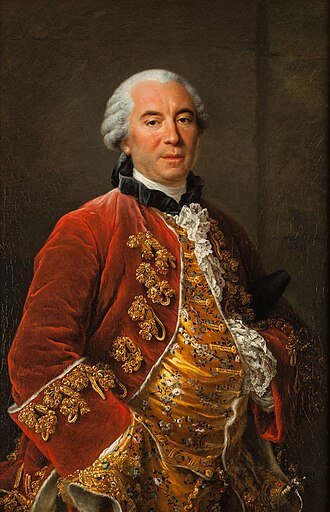 AuthorGeorges-Louis Leclerc, Comte de Buffon1707–1788
Histoire naturelle, générale et particulière, avec la description du Cabinet du Roi is the work for which Georges Louis Leclerc, Comte de Buffon (1707-1788), is remembered. It was published in quarto in 36 volumes between 1749 and 1789, to which eight more were added after his death, edited by Bernard Germain de Lacépède and other collaborators. Buffon worked on it for some fifty years, first in his office in the Tour Saint-Louis at Montbard and later in his library at Petit Fontenet.
The encyclopaedia gathers what was known in his day about the "natural sciences", a broad term that included what would now be called materials science, physics, chemistry and technology, alongside the natural history of animals. The structure follows a thematic order: a general introduction on method and the theory of the Earth, then the quadrupeds (volumes IV to XV), birds (XVI to XXIV), minerals (XXV to XXIX), a group of supplements on geology and related topics with further quadrupeds (XXX to XXXVI), reptiles and snakes, fishes and, finally, cetaceans. Each group opens with a general essay, and each animal receives an extended article written as a continuous discourse rather than as a classificatory entry.
Buffon paid close attention to internal anatomy, which places him among the early precursors of comparative anatomy. He noted morphological similarities between humans and apes, though he held that apes were entirely lacking in the capacity for thought. For him, the interior of living things was the foundation of nature's design.
The work enjoyed enormous success among a wealthy readership: the first three volumes were reprinted three times in six weeks. It also drew criticism from some priests for asserting that the Earth was more than six thousand years old, contrary to the biblical account. It was translated into several languages, including English, German, Swedish, Italian and Russian. Its influence extended into later natural history; the evolutionary biologist Ernst Mayr regarded it as the starting point for much of the thinking about natural history of its era.
Themes
Original Filopedia text based on Wikipedia (es) and Wikipedia (en) and Wikidata.