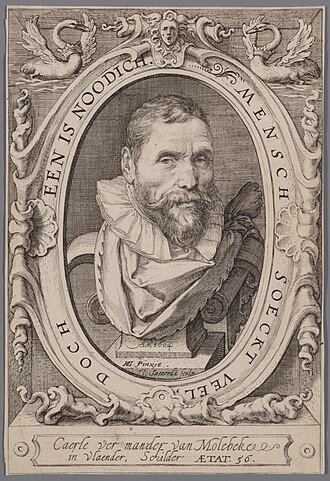
 AuthorKarel van Mander the Elder1548–1606
Het Schilder-Boeck, usually rendered in English as 'The Book of Painters', was written by the Flemish writer and painter Karel van Mander and first published in 1604 in Haarlem, in the Dutch Republic, where the author lived. Written in seventeenth-century Dutch, it is considered one of the principal sources for the history of art and art theory in the Low Countries of the fifteenth and sixteenth centuries. It was very well received and sold well, although Van Mander died two years after its appearance.
The work is divided into six parts, each with its own title page and index. The first sets out the foundations of the noble and free art of painting, in fourteen chapters on subjects such as landscape, animals, drapery and the arrangement of subjects. The next two gather biographies of ancient painters, Egyptian, Greek and Roman, drawn almost entirely from Pliny's Natural History, and of modern Italian painters, translated and updated from Vasari's Lives, to which Van Mander added artists of his own time. The fourth part, devoted to Netherlandish and German painters, is the most original: here Van Mander sought to correct the notion, inherited from Vasari, that the van Eyck brothers were the fathers of a northern painting centred on Bruges, and he assembled a large number of masters from the Low Countries and Germany. The fifth part is a commentary on Ovid's Metamorphoses, and the sixth deals with the depiction of figures.
The making of the book was not easy. Van Mander struggled to gather accurate information during a period of political and religious upheaval, and he wrote in a country where Calvinists were powerful and religious art was viewed with suspicion. Patronage therefore shifted towards genre scenes and historical allegories, and subjects considered politically safe were favoured. The work also belongs to Haarlem's effort to reinvent its glorious past after losing its appeal as a pilgrimage site for St Bavo.
After the author's death, a second edition appeared in 1618 that included a brief anonymous biography of Van Mander, probably written by his brother or his son. Its reliability is limited, but it remains the chief source on his life. Hessel Miedema translated this edition into English in 1994-1997, accompanied by a facsimile of the original and five volumes of notes.
Themes
Original Filopedia text based on Wikipedia (es) and Wikipedia (en) and Wikidata.