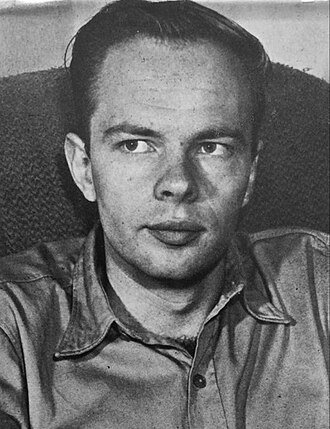
 AuthorPhilip K. Dick1928–1982
Flow My Tears, the Policeman Said is a science fiction novel written in 1974 by the American author Philip K. Dick. It won the John W. Campbell Memorial Award for Best Science Fiction Novel in 1975 and was a finalist for the Nebula Award in 1974 and the Hugo Award in 1975. The title refers to "Flow, my tears", a lute song by the Elizabethan composer John Dowland, whose lines open each major section of the book.
The story takes place in a dystopian 1988, after a second civil war that brought down the democratic institutions of the United States. The National Guard and the police restored order through a dictatorship headed by a "Director". Resistance survives mainly on university campuses, where radicalised former students live in underground communities. Recreational drug use is widespread, the age of consent has been lowered to twelve, and the Black population has nearly disappeared. Travel is largely by private light aircraft.
The protagonist is Jason Taverner, a singer and television star who has been genetically enhanced and belongs to an elite class known as the "Sixes". One morning he wakes in a shabby hotel to find that no one recognises him: his identity, his records and his very existence have been erased. Without papers he risks forced labour, and his journey through a watched society takes him to a document forger, to an inspector who detains and then releases him, to a former lover, and finally to the police general Felix Buckman, who interrogates him and keeps him under surveillance.
The novel weaves the search for identity together with suspicion of a conspiracy. Dick asks questions about fame, about the value we assign to someone for what they mean to others, about the manipulation of reality and about our dependence on technologies of control. The plot turns on an experimental drug that alters reality, and its explanation remains, for some readers, a weak point in an otherwise tightly built work.
Dick later recalled that the novel's closing scene, in which Buckman unexpectedly shows humanity toward a Black stranger at a gas station, was pointed out to him by an Episcopal priest as an echo of a passage in the Acts of the Apostles. Years afterwards the author described a similar episode from his own life, which led him to reflect on the coincidences between his fiction and his experience. Critics of the time praised the book's psychological portrait of the nightmare, though some objected to its final explanation of events.
Themes
Other works by Philip K. Dick
Original Filopedia text based on Wikipedia (es) and Wikipedia (en) and Wikidata.