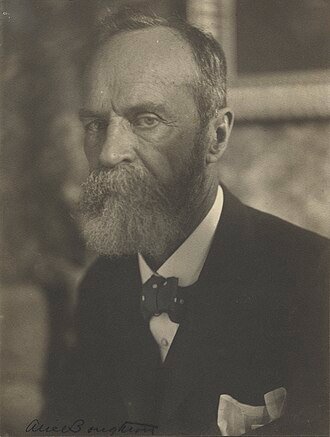
 AuthorWilliam James1842–1910
Essays in Radical Empiricism is a collection of articles by William James, edited and published posthumously in 1912 by his colleague and biographer Ralph Barton Perry. It gathers ten of twelve journal articles that James had published between 1904 and 1905 and which, in August 1906, he deposited at the Harvard University Library and the Harvard Department of Philosophy for supplementary use by his students. Perry replaced two of the original texts with two others, one of which did not yet exist at the time of the first list. Although the book presents itself as a unified work, it is in fact a set of writings produced over a period of years and never arranged by their author, so it is not a systematic statement of his thought, despite what Perry's preface suggests.
The central idea of radical empiricism is that experience, as it is directly given, is the basis of all knowledge, and that one should not assume at the outset a separate mental substance distinct from objects. James argues that consciousness is not an entity but a function that relates the things of experience, and that the relations between them are as real as the terms they connect. From this standpoint he discusses the distinction between subject and object, the knowledge shared by two minds, and the charge of solipsism levelled against him. Views on truth and humanism, closely related to pragmatism, also appear in several of the essays.
The book is best understood in light of its history. James's position developed over time, and the essays reflect different stages of that process, which accounts for the wide range of interpretations radical empiricism has received from commentators and critics. Some of the material was later incorporated into other books of his, such as The Meaning of Truth and A Pluralistic Universe. Today it is valued chiefly as a key to understanding James's late metaphysics and his attempt to move beyond the dualism between mind and world.
Themes
Books to read
- Essays in Radical Empiricism EnglishEPUB 229 KBRead online
Other works by William James
Original Filopedia text based on Wikipedia (es) and Wikipedia (en) and Wikidata.