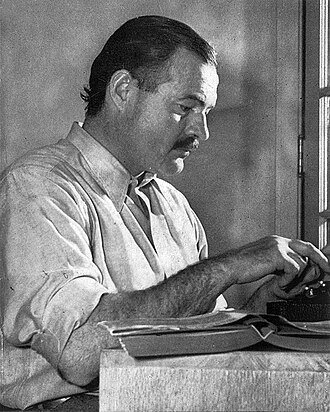
 AuthorErnest Hemingway1899–1961
The Old Man and the Sea is a novella by Ernest Hemingway, written between December 1950 and February 1951 in Cuba and published in 1952. It was the last major work of fiction the author saw published during his lifetime and, over time, one of the best known of his output.
The story centres on Santiago, an elderly fisherman who has gone eighty-four days without catching anything, a streak the village regards as extreme bad luck. Manolin, a boy whom Santiago once taught the trade, has been forced by his parents to work on a different boat, though he still visits the old man, helps him with his gear and brings him food. One morning Santiago sets out alone and heads into the Gulf Stream. After hours of waiting he hooks a giant marlin, which is so heavy that it drags the skiff far out to sea over three days. During this time Santiago alternates between exhaustion and clarity, remembers his youth, and develops toward the fish a mixture of admiration and respect that turns the catch into something like a duel.
When he finally harpoons the marlin and lashes it to his boat, its blood draws sharks. Santiago kills several, but loses his harpoon and then the knife he had fixed to an oar. By the time he reaches the coast the fish has been almost entirely eaten, leaving only the skeleton. The old man collapses, exhausted, in his shack, while Manolin, moved, promises to fish with him again.
The novella first appeared in Life magazine, which sold a record 5.3 million copies in two days, and soon after as a book. Its early reception was very favourable, and many critics saw it as Hemingway's return to form after the negative response to Across the River and Into the Trees. Over time some specialists judged the initial enthusiasm excessive, and the debate over whether it equals or falls short of the rest of his work remains open. The novel won the Pulitzer Prize for Fiction in 1953 and was the only book explicitly cited when Hemingway received the Nobel Prize in Literature in 1954.
The text has been read in many ways: its religious symbolism, its links with other works by the author, and Santiago as an embodiment of a man who struggles with dignity in the face of defeat have all been studied. Attention has also been paid to the protagonist's possible origins, which some critics connect with Canarian emigration to Cuba.
Themes
Other works by Ernest Hemingway
Original Filopedia text based on Wikipedia (es) and Wikipedia (en) and Wikidata.