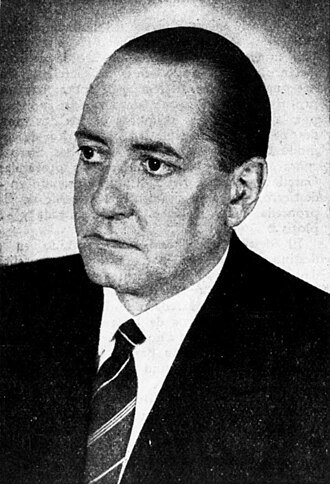
 AuthorAlejo Carpanter1904–1980
The Kingdom of This World is a novel by the Cuban writer Alejo Carpentier, published in 1949 in Mexico, with later editions appearing in Chile. Its central subject is the Haitian Revolution, and the book has been widely admired by critics, so that it now belongs to the academic canon of Spanish American literature.
Carpentier wrote the novel after a period shaped by his years in Europe, where he became absorbed in the Baroque and in surrealism, and by his return to Cuba in 1939. There he developed an interest in Afro-Cuban culture, partly after attending a voodoo ceremony. In 1943 he travelled to Haiti, a journey that proved decisive: he visited the Laferrière fortress, built by the emperor Henri Christophe. These experiences fed a project aimed at recovering the roots and history of the New World.
The prologue is among the author's most frequently quoted texts, since it sets out his notion of lo real maravilloso, or the marvelous real, which Carpentier presented as a distinctive feature of Latin America. It should not be confused with magical realism, a literary movement with which it is often wrongly identified. For Carpentier, the marvelous arises from an alteration of reality, from an unusual illumination of its hidden riches, or from a heightened state of the spirit, and it presupposes a prior faith in those who experience it.
The novel covers the period before, during and after the revolution that began in 1791 and led to Haiti's independence in 1804. Its protagonist, Ti Noel, is an enslaved man who cannot read and who passes through several masters, from Lenormand de Mezy in Saint-Domingue to a brief stay in Cuba. He eventually sees the kingdom of Christophe reproduce the same injustices it was meant to end. Alongside him appear historical figures such as François Mackandal, whose death at the stake becomes a legend among the enslaved, and Bouckman, who leads a more effective rebellion. The book alternates between the perspective of the enslaved, who see in Mackandal's transformation a liberating miracle, and that of the colonists, who perceive no such change.
Its structure interweaves history and fiction and relies on repetition to stress the cyclical nature of events, a feature that scholars have both praised and criticised. The novel was largely well received, and its treatment of the marvelous is regarded as a fundamental contribution to the later development of Caribbean and Latin American narrative.
Themes
Other works by Alejo Carpanter
Original Filopedia text based on Wikipedia (es) and Wikipedia (en) and Wikidata.