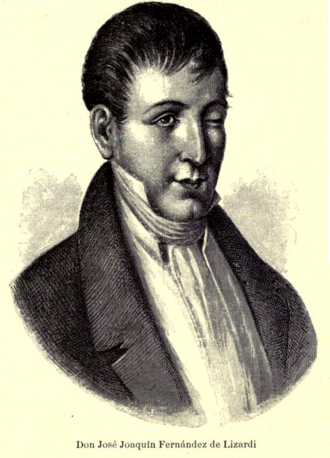
 AuthorJosé Joaquín Fernández de Lizardi1776–1827
El Periquillo Sarniento is a novel by the Mexican writer José Joaquín Fernández de Lizardi, written in 1816 during the War of Independence in Mexico. It is generally regarded as the first novel written and published in Latin America. Government censorship delayed the publication of the final volumes until 1831, after the author's death.
The work follows Pedro Sarmiento, nicknamed "Periquillo Sarniento" or "Mangy Parrot," a young man from a Creole family in Mexico City with more pretensions to good birth than means of support. His life is a succession of attempts to make a living without effort: student, friar, gambler, notary, barber, pharmacist, doctor, beggar, soldier, a self-styled count, and thief. Only after many misfortunes does he finally embrace an honest life. All of this unfolds at the close of the viceregal era, and the story takes the form of a testimony the protagonist dictates to his children late in life.
The novel blends the humor of the picaresque with a moralizing and critical intent: through the repentant voice of Periquillo, Lizardi denounces the ignorance, superstition and corruption of colonial administration. Its language, full of Mexicanisms and the speech of common people and the underworld, also makes it a valuable record of the society of its time.
Although its first volumes appeared in 1817 and the fourth was censored for criticizing slavery, the work had lasting influence. It is considered a precursor of the Mexican novel of the nineteenth century, and many readers and critics have seen it as an important step in the formation of a national consciousness.
Themes
Original Filopedia text based on Wikipedia (es) and Wikipedia (en) and Wikidata.