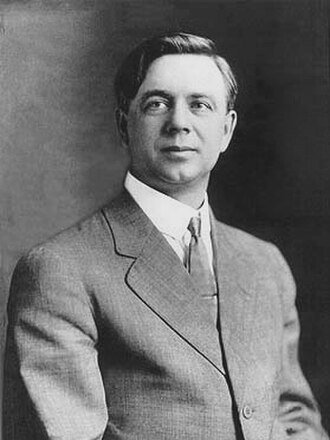
 AuthorWilliam S. Sadler1875–1969
The Urantia Book, also known as The Urantia Papers or The Fifth Epochal Revelation, is a spiritual, theological and philosophical work about God, humanity, religion, philosophy and destiny. It was written between 1922 and 1939 and first published in the United States in 1955. The text claims to have been written by celestial beings, some of whose voices speak in the first person at the end of certain papers, through a sleeping human individual who served as a means of contact.
The origins of the book are disputed. Around 1911, the Chicago physicians Lena and William S. Sadler reportedly observed episodes in which a neighbor fell into a deep sleep and spoke in words that seemed to come from extraplanetary beings. From 1925 onward, handwritten documents became the regular means of communication. Around 1923 a forum of friends, former patients and colleagues had gathered around Sadler to pose questions, and from it emerged a five-member Contact Commission that collected the answers and prepared the text. Sadler himself had published a book in 1929 criticising spiritualist practices, and in an appendix admitted he could not explain one case. Some researchers have proposed that several people from the group wrote or edited the text, and a stylometric analysis has suggested multiple authors.
The book has a foreword and four parts. The first describes the central universe, the superuniverses and celestial hierarchies. The second deals with the local universe, the establishment of life and Lucifer's rebellion. The third traces the history of the Earth, which the book calls Urantia, from before the solar system formed up to the time of Jesus, with geological, social and cultural analysis. The fourth, which occupies about a third of its length, narrates the life and teachings of Jesus of Nazareth.
The book holds that it presents an epochal revelation for the planet and seeks to synthesise religion, science and philosophy. Its reception has been deeply divided: for its readers it is a profound spiritual revelation, while others regard it as fiction or as a compilation of human sources. There is no official interpretation of the text and no organisation that defines an orthodoxy, so each reader interprets it according to their own judgement. The Urantia Foundation, based in Chicago, publishes and protects the translations, and since 2001 the English text has been in the public domain in the United States.
Themes
Original Filopedia text based on Wikipedia (es) and Wikipedia (en) and Wikidata.