The Closing of the American Mind
essay on cultural and educational criticism · 1987
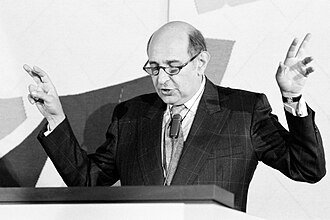 AuthorAllan Bloom1930–1992
The Closing of the American Mind is a 1987 book by the philosopher Allan Bloom, a professor at the University of Chicago. Its central thesis is paradoxical: the "openness" of relativism, so celebrated in academia and American society, actually leads to a "closing" of the mind, because it deprives thought of the ability to ask questions and to distinguish true from false. For Bloom, value relativism, which holds that all moral beliefs are equivalent and that none can be discovered by reason, undermines critical thinking and eliminates the point of view that defines a culture.
The book is divided into several parts. In the first, titled "Students", Bloom describes how American youth culture, with its music, books, relationships, and the influence of an expanded middle class that weakened parental authority, has left young people without a habit of reading or any interest in the great books of the Western tradition, such as Plato's Republic or Machiavelli's The Prince. Without these reference texts, students lack criteria by which to judge events and are left with vague notions of "good" and "evil". In the second part, "Nihilism, American Style", Bloom develops the idea that relativism has turned into nihilism, and he blames analytic philosophy and deconstructionism for neglecting ethical and political questions and for undermining the notion of a truth accessible to reason. He also draws an analogy between the American society of his time and the Weimar Republic, in which a moral void could be exploited by demagogic radicals. The third part, "The University", examines the role of elite institutions, which in his view have cultivated ambition rather than the pursuit of truth, and distinguishes the philosophic life from the university as an institution.
The book was controversial. Its criticism of contemporary academic movements and popular culture made it a reference point in debates about higher education in the United States. Unexpectedly, it achieved considerable commercial success, selling close to half a million hardcover copies, which carried it well beyond academic circles. Its supporters read it as a call to recover the classical liberal tradition; its detractors accused it of elitism and of nostalgia for an elite culture. It remains a work cited in discussions about the canon, freedom of thought, and the role of the university.
Themes
Original Filopedia text based on Wikipedia (es) and Wikipedia (en) and Wikidata.