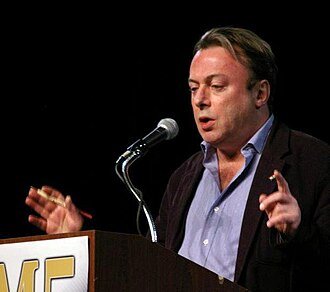
 AuthorChristopher Hitchens1949–2011
God Is Not Great (sometimes stylized as god is not Great) is a 2007 book by the journalist Christopher Hitchens (1949–2011) in which he makes a case against organized religion. It was first published in the United Kingdom under the subtitle The Case Against Religion and in the United States as How Religion Poisons Everything; in 2017 the British publisher reissued it without a subtitle. Hitchens's central claim is that organized religion is "violent, irrational, intolerant, allied to racism, tribalism and bigotry, invested in ignorance and hostile to free inquiry, contemptuous of women and coercive toward children", and that it therefore has a great deal on its conscience. The title negates the Muslim affirmation Allahu akbar, usually rendered as "God is great".
The book mixes personal stories, documented historical anecdotes and critical readings of sacred texts. Hitchens focuses mainly on the Abrahamic religions, though he also turns his criticism on Hinduism and Buddhism. After an introduction in which he presents himself as an atheist and suggests that faith persists largely out of human fear of mortality, he surveys the violence linked to conflicts in cities such as Belfast and Beirut and to the fatwa against Salman Rushdie. He denounces religious interference in public health, from opposition to condoms in Africa to resistance to vaccines and to circumcision, and he examines the metaphysical claims of religion and the argument from design, which in his view cannot survive contact with evolution.
A large part of the book is devoted to the Bible. Hitchens describes the Old Testament as a repertory of cruelty and inconsistency and the New Testament as a derivative, historically unreliable text full of contradictions. He then turns to Islam, which he regards as indebted to Jewish and Christian traditions and as resistant to criticism in a way he reads as a sign of insecurity rather than of truth. The final chapters address miracles, which he holds to be unsupported by verifiable testimony; the origin of some religions in fraud or superstition, with examples such as Mormonism and the cargo cults; the supposed moral function of faith, which he rebuts by pointing to the abolitionist movement; and the claim that eternal punishment, blood sacrifice and sexual repression are sources of morality, which he considers positively immoral. He concludes that humanity will probably outgrow religion and that meaning and community can be found through secular, non-coercive means.
The reception was sharply divided. It sold well, reaching No. 2 on the Amazon bestseller list in its first week and No. 1 on The New York Times list in its third. Critics such as Michael Kinsley and Bruce DeSilva praised its biting prose and sharp arguments and considered it among the most notable atheist books since Bertrand Russell's Why I Am Not a Christian. Others faulted the author for historical and textual errors, an overly literalist reading of the Bible and a sweeping condemnation of religion that ignores theological tradition and scholarship. Among his critics were the theologian David Bentley Hart, the historian of religion Stephen Prothero and the Islamicist Daniel C. Peterson.
Themes
Other works by Christopher Hitchens
Original Filopedia text based on Wikipedia (es) and Wikipedia (en) and Wikidata.