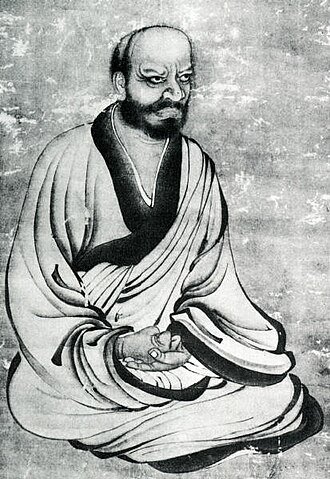
 AuthorLinji Yixuan850–866
The Sayings of Linji (Linji yulu, in Chinese) is the collection of teachings attributed to Linji Yixuan, a monk and teacher of the Hongzhou school of Chinese Chan who died in 866 during the Tang dynasty. It is regarded as one of the foundational texts of Chan Buddhism and an example of the iconoclastic and antinomian spirit associated with the tradition.
Linji was born around the Yuanhe era (806-820) in what is now Shandong province. After taking full monastic vows he studied the vinaya, the sutras and the treatises of the Mahayana, especially the teachings of the Huayan and Yogācāra schools. In his thirties he turned away from study towards meditation. He trained under Huangbo Xiyun, who struck him several times, and a famous awakening followed an encounter with the recluse Dàyú. He then went on pilgrimage and, around 851, settled at the Linji temple on the banks of the Hutuo River in Zhenzhou, where he taught for about a decade. The temple gave him his name. He spent his last years in Weifu, where he died in 867, and was posthumously granted the title Meditation Master of Illuminating Wisdom.
The work did not reach its definitive form until long after his death. His disciples passed on his words orally and in writing, but the standard edition that survives was completed in the eleventh century, shaped considerably by the Linji school of the Song dynasty, which created mythic stories about its founder. For this reason, the historical man is wrapped in legend, and scholars try cautiously to separate what may be his from later additions. The texts mix formal sermons with dialogues and short episodes in which the master answers with shouts, blows or puzzling phrases, breaking with the religious conventions of his age.
The Linji school, which grew out of his descendants, became one of the most widespread currents of Zen in East Asia, with branches in Japan (Rinzai), Korea (Seon) and Vietnam (Lâm Tế).
Themes
Original Filopedia text based on Wikipedia (en) and Wikidata.