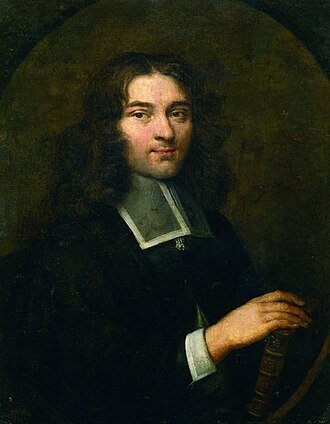
 AuthorPierre Bayle1647–1706
The Historical and Critical Dictionary (Dictionnaire historique et critique) is a work by Pierre Bayle (1647–1706), a Huguenot philosopher who lived and published in Rotterdam, in the Dutch Republic, after fleeing France because of religious persecution. Bayle began by noting errors and omissions in Louis Moreri's earlier encyclopedia, the Grand dictionnaire historique (1674), and these notes gradually grew into a work of his own. The first edition appeared in 1697 in two volumes, each in two parts, and the second edition of 1702 enlarged it to three volumes. An English translation was first published in 1709.
Although the overwhelming majority of its entries are devoted to historical or mythical people, many articles deal with religious beliefs and philosophical doctrines. Much of the most controversial material is tucked away in its lengthy footnotes or slipped into articles with seemingly harmless titles. Bayle uses the irrationality of Christianity as an argument: he highlights the contradictions between theological tenets and what reason regards as self-evident, in order to show that the basis of Christian faith is belief in God and divine revelation. At the same time he defends religious tolerance and opposes the rigid, authoritarian enforcement of articles of faith, a stance that drew him into a bitter dispute with his fellow Protestant Pierre Jurieu.
Its rigorous, skeptical method influenced Enlightenment thinkers such as Denis Diderot and the other French Encyclopédistes, David Hume and George Berkeley.
Themes
Original Filopedia text based on Wikipedia (es) and Wikipedia (en) and Wikidata.