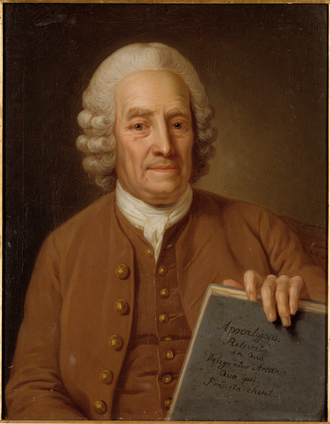
 AuthorEmmanuel Swedenborg1688–1772
Heaven and Hell is a book written in Latin by the Swedish scientist and philosopher Emanuel Swedenborg and published in 1758. Its full Latin title, De caelo et ejus mirabilibus et de inferno, ex auditis et visis, roughly means "On Heaven and Its Wonders, and on Hell, from Things Heard and Seen," and it states the author's method: to describe what he said had been revealed to him and shown to him directly in the spiritual world.
The book gives a detailed account of life after the death of the physical body. Swedenborg argues that God is love itself and that his purpose in creating was for everyone to reach heaven, so God never angers or casts anyone into hell. The images of an angry God found in the Bible are explained as accommodations to the limited understanding of people in ancient times. According to the author, angels are human beings who have passed into spiritual life. They live in a real world, with bodies, houses, landscapes and activities similar to earthly ones, although their surroundings reflect, or "correspond" to, their inner state. Children who die go straight to heaven. After death, a person passes through an intermediate state, the so-called "world of spirits," where pretense is gradually lost and the inner self is revealed. This stripping bare, which Swedenborg calls judgment, leads each person to freely choose heaven or hell, joining those who are alike in character.
The work gives special attention to marriage, which Swedenborg considers continuous beyond death, and to the Christian love between one man and one woman, which he regards as the highest of joys. He rejects polygamy because he believes it destroys the spiritual union of two minds into one.
Its reception was broad. It was translated into many languages and influenced very different figures, among them Johnny Appleseed, Ralph Waldo Emerson, Carl Jung, Jorge Luis Borges and W. B. Yeats. William Blake, raised in a Swedenborgian family, annotated his copy and criticized the author in The Marriage of Heaven and Hell. Edgar Allan Poe mentions it in The Fall of the House of Usher, and Balzac gives it an important role in his novel Louis Lambert. In religious circles, some historians have pointed to parallels with the Mormon doctrine of three degrees of glory, although many similarities, as has been noted, come from shared readings of biblical texts.
Themes
Other works by Emmanuel Swedenborg
- Arcana Cœlestia 1756
Original Filopedia text based on Wikipedia (es) and Wikipedia (en) and Wikidata.