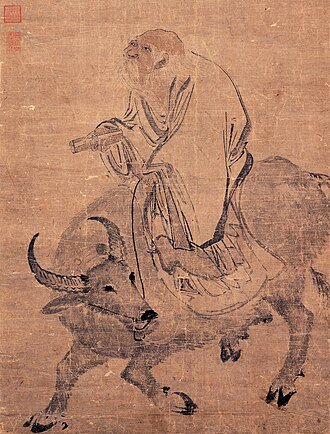
 AuthorLaozi579 BC–500 BC
The Dào Dé Jīng, also known as the Tao Te Ching or simply the Laozi, is one of the foundational texts of Chinese thought. Its title comes from the words that open its two parts: dào, 'the way', which begins chapter 1, and dé, 'virtue' or 'power', which begins chapter 38, to which the word jīng, 'classic book', is added. According to tradition, it was written around the sixth century BCE by Laozi, an archivist at the court of the Zhou dynasty, although the historical existence of this figure and the authorship of the text remain debated among scholars.
The date of composition is also uncertain. Archaeological discoveries have reshaped the discussion: the bamboo fragments from Guodian, dating to around 300 BCE, contain much of the text in a shorter form, and the silk manuscripts from Mawangdui, from around 200 BCE, show that versions close to those we read today were already circulating in essence in antiquity. For this reason, most specialists place the final redaction around the third century BCE, drawing on earlier materials.
The book comprises some five thousand Chinese characters arranged in 81 short chapters, divided into two parts: the Daojing (chapters 1 to 37), more metaphysical, and the Dejing (chapters 38 to 81), more concerned with government and conduct. It is written in a terse, poetic style with very few grammatical particles, which leaves room for a wide range of interpretations. Its central ideas include the Dao as an ineffable principle underlying all things, the importance of nothingness and emptiness, the value of the yielding, the soft and the feminine over rigidity, the view that excessive desire and ambition lead to violence, and the wisdom of acting in harmony with the natural course of things rather than imposing oneself on them.
Its influence has been immense. It forms the basis of philosophical Taoism and carried considerable weight over Legalism and Neo-Confucianism. It played a decisive role in Taoist religious practice and in Chinese Buddhism, whose arrival was largely interpreted through Taoist terms. For centuries it has also inspired painters, calligraphers, poets and garden designers. Outside China it has been translated into countless languages and ranks, after the Bible, as one of the most translated texts in world literature.
Themes
Books to read
- Dao De Jing: A Minimalist Translation EnglishGutenberg
Original Filopedia text based on Wikipedia (es) and Wikipedia (en) and Wikidata.