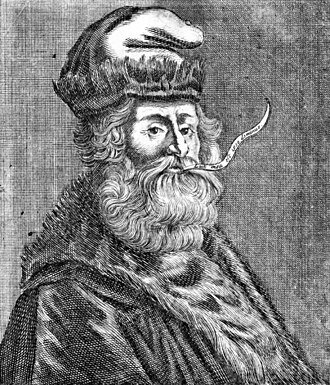
 AuthorRamon Llull1232–1316
Blanquerna, whose full title is The Romance of Evast and Blaquerna (Old Catalan Romanç d'Evast e Blaquerna), is a novel written in Catalan between 1283 and 1285 by the Majorcan Ramon Llull. It follows the life of its eponymous hero, son of Evast and Aloma. It is the first major literary work written in the Balearic Islands and is regarded as a founding text of Catalan literature and one of the first European novels.
The work is divided into five parts. Evast, a nobleman, had wished to live a religious life before marrying, yet also wanted to experience matrimony; after his marriage to Aloma he became a merchant and raised his son in religious and philosophical pursuits. Blanquerna faces the same choice between celibacy and marriage: he decides to become a hermit, to his mother's dismay, and persuades Cana to become a nun. He also resists sexual temptation in the form of the maiden Natana, and the second part includes a description of the seven deadly sins. In the later parts, as a monk and abbot, he is eventually elected pope after a path marked by doubts and mistakes, which makes him a more credible figure. With the help of a jongleur, a "wise fool" named Ramon, he reforms the Church and finally retires as a hermit, where he composes the Llibre d'Amic e d'Amat, a book of meditations made up of 365 love poems intended as a guide to contemplation.
The novel blends social satire, adventure narrative and an apostolic utopia of Christian reform, and its reception has established it as a landmark of Lullian thought and of medieval Catalan prose.
Themes
Other works by Ramon Llull
Original Filopedia text based on Wikipedia (en) and Wikidata.