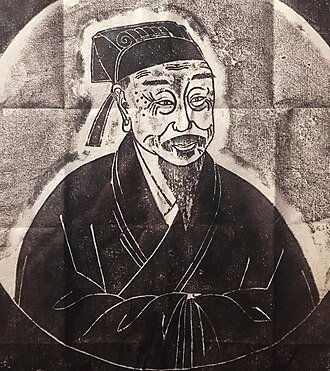
Zhu Xi
1130–1200 · Chinese Neo-Confucian philosopher of the Song dynasty
Early Life and Upbringing
Zhu Xi was born on October 18, 1130, in Fujian, though his family originated in Wuyuan County in the former prefecture of Huizhou, in today's Jiangxi province. His father served as a subprefectural sheriff. When he was forced from office in 1140 for opposing the government's policy of appeasement toward the Jurchen, the boy was taught at home. Many anecdotes attest to his precocity: it is recorded that at five he asked what lay beyond Heaven, and that by eight he understood the meaning of the Classic of Filiality (Xiaojing). As a youth he was struck by Mencius's claim that anyone could become a sage.
Studies after His Father's Death
His father died in 1143, and Zhu Xi was guided by friends of the family, among them Hu Xian, Liu Zihui and Liu Mianzhi, who shaped his studies. In 1148, at nineteen, he passed the imperial examination and obtained the jinshi degree, one of the highest distinctions in the official career path.
First Posts and Teaching under Li Tong
His first post was as registrar of the subprefecture of Tong'an, which he held from 1153 to 1156. From 1153 he studied under Li Tong, an heir to the tradition of the Cheng brothers, Cheng Hao and Cheng Yi, and in 1160 he formally became his student. These years were highly productive for his thought and scholarship. After 1156 he held no official post for a long time and devoted himself mainly to writing, editing and teaching.
Doctrine: Qi, Li and the Supreme Ultimate
According to Zhu Xi, all things come into being through the union of two universal aspects of reality: qi, vital or material force, and li, rational principle or order. The source and sum of li is the taiji, the Supreme Ultimate. Every object and every person possesses its li and, at its metaphysical core, is in contact with the taiji. The human mind, understood as the manifestation of that creative principle, works together with qi in mutual dependence. Zhu Xi also held that li existed even before Heaven and Earth, and that qi explained wrongdoing: a person's qi might be turbid and obstruct the innate goodness of their nature. The moral task therefore lies in clarifying qi. His system resembles in form certain Buddhist ideas about principle and affairs, although he and his followers insisted that they were drawing on concepts already present in the I Ching.
Method: Investigation of Things and Meditation
Zhu Xi advocated the "investigation of things" (gewu), which meant examining carefully both books and the affairs of the world, since moral principles were inexhaustible. For him, knowledge and action were inseparable: knowledge had priority in order, while action had greater importance in its effects. He also practised a daily meditation called jingzuo, which did not demand emptying the mind as in some forms of Buddhism, but a calm introspection that balanced one's personality and fostered concentration and harmony with the universe. He believed in spirits and in divination, and he lamented the proliferation of books that printing made possible, since he thought it scattered students' attention.
The Four Books and the White Deer Grotto Academy
Unlike other Neo-Confucians, who focused on the I Ching, Zhu Xi placed the emphasis on the Four Books: the Great Learning, the Doctrine of the Mean, the Analects and Mencius. He wrote extensive commentaries on them which were not widely recognised in his lifetime, but which eventually became the standard reference. Disappointed by local schools, he founded his own academy, the White Deer Grotto, to educate students properly. Later, in 1179, he was appointed prefect of the Nankang military district, where he revived the academy, though he was demoted three years later for denouncing the incompetence and corruption of influential officials.
Political Conflict, Death and Rehabilitation
His political career was irregular: he was appointed to tasks several times and dismissed from them just as often. When he was removed from his last post he was accused of numerous crimes and a petition for his execution was made, largely at the instigation of the prime minister Han Tuozhou, his political rival. Although his teachings were fiercely attacked by the establishment, almost a thousand people attended his funeral in 1200. After Han Tuozhou's death, his disciples Zhen Dexiu and Wei Liaoweng made his school the dominant philosophy at the Song court. In 1208 Emperor Ningzong rehabilitated him and granted him the posthumous name Wen Gong, "venerable gentleman of culture". In 1241 a memorial tablet to him was placed in the Confucian temple at Qufu.
Legacy and Influence
From 1313 to 1905 his commentaries on the Four Books formed the basis of the Chinese civil service examinations. His thought later dominated subsequent Neo-Confucians, although dissenters emerged, such as Wang Yangming and the School of Mind. His doctrine spread to Japan, where it was known as shushigaku, to Korea, where it became orthodoxy, and it also influenced Vietnam. In the twentieth century Feng Youlan reinterpreted his concepts of li, qi and taiji within a new metaphysical theory.
Calligraphy
Zhu Xi studied calligraphy from an early age, following his father and several masters of the period. He began with the style of Cao Cao and later specialised in the regular script of Zhong Yao and the cursive script of Yan Zhenqing. His fame as a philosopher largely overshadowed his calligraphic talent, and today what survives are mostly short notes in running script. His strokes were considered smooth, firm and balanced, and he maintained that calligraphy should observe the rules without being bound by them, in order to express naturalness.
Key ideas
- The Four Books as the core curriculum: Zhu Xi chose these four classics as the essential syllabus and wrote commentaries that became the standard reference.
- Li and qi: li is the rational principle that orders each thing, while qi is the vital or material force that gives concrete beings their form.
- The Taiji as Supreme Ultimate: li has its source in the Taiji, which Zhu Xi understood as a dynamic creative principle rather than a still void.
- Investigation of things (gewu): knowledge is reached by studying objects and texts methodically, not by sudden intuition.
- Moral cultivation and clear qi: human nature is good at its core, and the moral task is to purify the qi that obscures it.
Works in Filopedia
Books to read
- 近思錄 ChineseEPUB 155 KBRead online
Curiosities
A question at five
According to transmitted anecdotes, at the age of five he asked what lay beyond Heaven, an early sign of his curiosity.
A crowded funeral
Although his teachings had been harshly attacked by government figures, almost a thousand people attended his funeral.
A tablet at Qufu
In 1241 a memorial tablet to him was placed in the Confucian Temple at Qufu, elevating him to Confucian sainthood.
Original Filopedia text based on Wikipedia (es) and Wikipedia (en) and Wikidata.