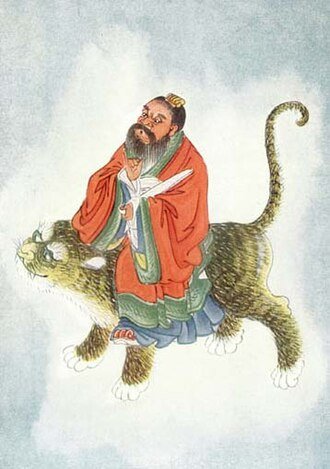
Zhang Daoling
34–156 · legendary founder of the Way of the Five Pecks of Rice
Zhang Daoling (traditionally Zhang Ling, c. 34-156) is regarded by Taoist tradition as the founder of the Way of the Five Pecks of Rice, the movement that gave rise to the Way of the Celestial Masters and, in the view of many scholars, to religious Taoism itself. His life is largely legendary. Nearly everything we know comes from scriptures and hagiographies compiled centuries after his death, so his biographical details should be read with caution.
According to these sources, he was born in Feng County, in present-day Jiangsu, and was said to descend from the statesman Zhang Liang. After a youth devoted to study of the Daodejing, he is said to have served as a magistrate in Jiangzhou and then withdrawn to Mount Beimang, where he practised methods of longevity. Around 142, on Mount Heming, the deified Laozi is said to have appeared to him, granted him the title of Celestial Master, and warned of plagues and demons. Only 240,000 people, he was told, would survive to inhabit the coming age of Great Peace.
He then gathered followers into parishes and set up a theocratic community in Sichuan. Outsiders called it the Way of the Five Pecks of Rice, after the grain tax paid by its adherents. His teaching linked bodily purification to purity of spirit, asked believers to confess their sins publicly as a path to forgiveness, rejected animal and food sacrifices, and relied on talismans and exorcisms. He is traditionally credited with the Xiang'er commentary on the Tao Te Ching, preserved in a sixth-century copy. It may reflect his ideas, though his authorship cannot be proven.
Tradition holds that he died on Mount Qingcheng at the age of 123, although some say he ascended to immortality instead. His son Zhang Heng and grandson Zhang Lu led the movement after him, and his family continued the line of Celestial Masters into modern times. His influence has outlasted the uncertain facts of his life. He is venerated in Taoism and across much of Southeast Asia as a protector against evil spirits.
Key ideas
- Way of the Five Pecks of Rice: a religious movement organised into parishes and funded by the offerings of its followers.
- Purification: cleansing the body is seen as the route to purifying the spirit.
- Public confession: admitting one's sins before the community is believed to secure heavenly forgiveness and good fortune.
- Rejection of sacrifice: the traditional offerings of animals and food were abandoned.
- Talismans and exorcism: seals and formulas were used to win the protection of heavenly powers against the coming cataclysm.
Curiosities
Bilocation
Tradition holds that, through his powers, he could appear in several places at once.
An exit without a body
One tradition holds that at his death he left only his clothes behind, having supposedly ascended to immortality in broad daylight.
Original Filopedia text based on Wikipedia (es) and Wikipedia (en) and Wikidata.