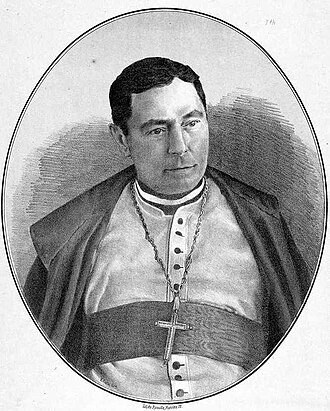
Zeferino González y Díaz Tuñón
1821–1894 · Dominican friar, Thomist philosopher and Spanish cardinal
Ceferino González y Díaz Tuñón (Villoria, 1831 – Madrid, 1894) was an Asturian Dominican who became Archbishop of Seville and a cardinal, and one of the leading Thomists in nineteenth-century Spain. His philosophy belongs to the effort to revive the thought of Thomas Aquinas in the face of modern currents.
He entered the Dominican Order at Ocaña and, after training in philosophy and theology, went to Manila, where he taught for many years at the University of Santo Tomas. There he combined teaching natural sciences with philosophy. Returning to Spain in 1867, he gave independent lectures in Madrid and published his Philosophia elementaria, a textbook covering logic, psychology, metaphysics and ethics that went through many editions. His three-volume Estudios sobre la filosofía de Santo Tomás is another well-known work.
He then held the sees of Córdoba, Seville and Toledo without giving up writing. His view holds that natural reason, arranged by the scholastic method, can reach truths about God, the soul and morality, and that faith and science do not contradict each other. His influence lived on through the pupils he trained, some of whom became bishops, and through the spread of Thomism in Spanish culture.
Key ideas
- Thomism: a defence of the philosophy of Thomas Aquinas as a basis for thinking about reality, God and the soul.
- Harmony of reason and faith: natural reason can reach truths about God and morality without opposing revelation.
- A teaching manual: his Philosophia elementaria organised the teaching of logic, psychology, metaphysics and ethics.
- Science and philosophy: his scientific training in Manila led him to write on natural phenomena without separating them from philosophical reflection.
Curiosities
Adopted son of Manila
He was given the title of adopted son of Manila, the city where he spent much of his teaching career.
Streets named after him
Today some of the main streets of Oviedo and Seville, and Madrid's Rastro market area, bear his name.
Original Filopedia text based on Wikipedia (es) and Wikipedia (en) and Wikidata.