Yusuf Khass Hajib
1017–1075 · Turkic poet, statesman and vizier from Central Asia
Yusuf Khass Hajib, better known as Yūsuf Balasaguni after his hometown, was an 11th-century poet, statesman and vizier born in Balasagun, capital of the Kara-Khanid Khanate in what is now northern Kyrgyzstan. He is also described as a Maturidi theologian and philosopher. His name is linked to one of the earliest major works written in a Turkic language during the Muslim cultural revival, which gives him a central place in the history of Turkic literature.
Most of what is known about him comes from his own writing. His father was a wealthy and well-regarded figure in the city, and the young poet received his early schooling there. His birth is usually dated to around 1017 or 1018, though the exact year is uncertain. At roughly fifty years of age, he finished his major poem, the Kutadgu Bilig ("Blessed Knowledge"), in Kashgar, around 1069 or 1070. He wrote it in the Turkic language of the Kara-Khanid period rather than in Arabic or Persian, a choice he himself explains at the start of the work.
After presenting the poem to Hasan ibn Sulayman, prince of Kashgar, he was given the honorific title Khāṣṣ Ḥājib, roughly comparable to Privy Chamberlain or Chancellor. Some scholars doubt that he wrote the prologue, which is more overtly Islamic than the rest and partly in prose. Accounts of his death are unreliable: he is said to have died and been buried in Kashgar around 1077, but claims about his exact age and grave are not documented.
His legacy is above all literary and symbolic. The Kutadgu Bilig is regarded as a foundational text by many Turkic peoples, who see it as the first masterpiece of their written tradition in the Muslim era. Today he is commemorated in Kyrgyzstan through monuments, street names and banknotes, and in 2016 the International Organization of Turkic Culture declared a year in his honour.
Key works
- Kutadgu Bilig (c. 1069-1070): a didactic poem on good government, justice and virtue, written in Karakhanid Turkic.
Curiosities
A mausoleum with a turbulent history
The mausoleum built in Kashgar in 1865 was destroyed in 1972 during the Cultural Revolution, and a school was built on the site. After Mao's death it was restored to its original location.
His face on a banknote
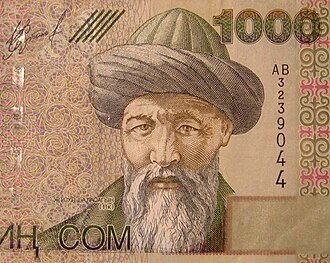
Balasaguni's image appears on Kyrgyzstan's 1000 som banknote.
Original Filopedia text based on Wikipedia (en) and Wikidata.