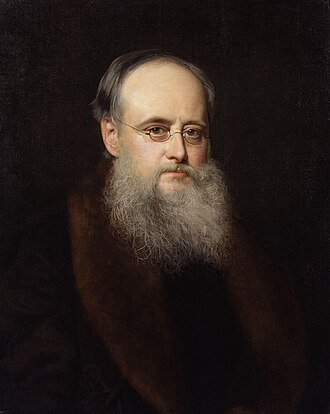
Wilkie Collins
1824–1889 · English novelist, playwright and short-story writer
Wilkie Collins (London, 1824 – London, 1889) was an English novelist, playwright and short-story writer who was highly popular in his lifetime. He is remembered as one of the creators of the modern detective novel, a writer of mystery, melodramatic suspense and meticulous narrative detail. His best-known works are still read as the foundation of the crime and sensation fiction that came after him.
The son of the landscape painter William Collins, he was named Wilkie after his godfather, the painter David Wilkie. Between the ages of twelve and fourteen he lived with his family in Italy and France, learning Italian and French, and the experience shaped him for life. He left school at seventeen and worked for several years as a clerk for a tea merchant, a job he disliked. He wrote a first novel in 1844, Iolani, or Tahiti as It Was, which was rejected and remained unpublished until 1999. He entered Lincoln's Inn to study law but never practised. His first published book, a memoir of his father, appeared in 1848.
A turning point came in 1851, when he met Charles Dickens through a mutual friend. The two became close friends and lifelong collaborators. They shared a love of the theatre, worked together on plays and fiction, and Collins contributed to Dickens's journals Household Words and All the Year Round. Their bond was so close that Collins's younger brother, Charles Allston Collins, married one of Dickens's daughters.
His fiction depends on intrigue, on stories told through several narrators, and on carefully managed suspense. Many of his novels were serialised, which forced him to pace the mystery week by week. The Woman in White (1860) was a huge success and brought him financial security for about a decade. Armadale (1866) drew harsh reviews and failed commercially despite a large advance. The Moonstone (1868) is now his most admired book and is seen as a forerunner of the English detective novel. Sergeant Cuff, one of its characters, is often considered a literary precursor of Sherlock Holmes.
From around 1860 gout led him to take laudanum for pain, and he became dependent on opium. The addiction damaged his health and his work, and The Moonstone itself deals with the effects of opium. After Dickens died in 1870, his later novels lost momentum: those of the 1870s and 1880s carry less suspense and more social criticism, and critics generally regard them as minor.
Collins never married. For decades he had relationships with Caroline Graves and later with Martha Rudd, with whom he had three children. He died in London in 1889 and was buried at Kensal Green Cemetery. His legacy is twofold: he is a master of Victorian suspense, and later crime writers owe him a clear debt.
Key works
- The Woman in White (1860): a serialised mystery built on a mysterious woman and a hidden family secret, a central work of sensation fiction.
- No Name (1862): a revenge thriller that criticises the legal treatment of children born to unmarried parents.
- Armadale (1866): a novel of crime and guilt centred on the transgressive Lydia Gwilt.
- The Moonstone (1868): often considered the first major English detective novel, told through several voices.
Where to start
The Moonstone 1868
The Moonstone is a detective novel told through letters, statements and diaries by several characters. It follows the theft of a valuable diamond from an English household and the investigation that surrounds it. It is a fast, entertaining read that shows the origins of the detective genre.
Next: The Woman in White. The Woman in White offers another great epistolary mystery, with a more gothic tone and a plot of impersonation and family secrets that rounds out the author's style.
Works in Filopedia
- The Woman in White 1860
- The Moonstone 1868
Books to read
- The Woman in White EnglishEPUB 704 KBRead online
- The Moonstone EnglishEPUB 541 KBRead online
- Hide and Seek EnglishEPUB 446 KBRead online
- The Dead Secret: A Novel EnglishEPUB 362 KBRead online
- Armadale EnglishEPUB 942 KBRead online
- No Name EnglishEPUB 714 KBRead online
- The Haunted Hotel: A Mystery of Modern Venice EnglishEPUB 302 KBRead online
- Basil EnglishEPUB 332 KBRead online
- The Law and the Lady EnglishEPUB 397 KBRead online
- The Lazy Tour of Two Idle Apprentices EnglishEPUB 141 KBRead online
- After Dark EnglishEPUB 391 KBRead online
- Man and Wife EnglishEPUB 620 KBRead online
- The Queen of Hearts EnglishEPUB 427 KBRead online
- The Evil Genius: A Domestic Story EnglishEPUB 343 KBRead online
Curiosities
An imagined double
According to biographical tradition, in his later years Collins believed a double of himself accompanied him, which he called 'Ghost Wilkie'.
A novel kept hidden for a century and a half
His first novel, Iolani, or Tahiti as It Was, written in 1844, was not published until 1999.
Teachers and influences
Influenced
- Dorothy L. Sayers 1893–1957
Original Filopedia text based on Wikipedia (es) and Wikipedia (en) and Wikidata.