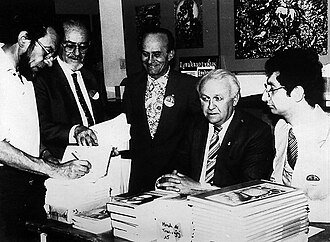
William Auld
1924–2006 · British poet and translator in Esperanto
William Auld (Erith, 1924 – Dollar, 2006) was a British poet, translator and magazine editor who wrote mainly in Esperanto, a language he took up as a teenager and built much of his work around. He was nominated several times for the Nobel Prize in Literature, making him the first person put forward for works written in Esperanto. His case matters both for his poetry and for what it suggested about an auxiliary language aiming at literature of the highest standard.
Born in Erith, Kent, he moved as a child with his family to Glasgow, where he attended Allan Glen's School. After wartime service as a Spitfire pilot in the Royal Air Force, he studied English literature at Glasgow University and trained as a teacher. He began learning Esperanto in 1937, but did not become fully involved in promoting it until after the Second World War. In 1952 he married Margaret Stewart, also an Esperantist, and in 1960 he took a post at a secondary school in Alloa, where he stayed for the rest of his life.
His first poetry book, Kvaropo (1952), gathered work by himself and three other poets and gave its name to the publishing house Stafeto, highly influential in the 1950s and 1960s. His most ambitious work is La infana raso, a long poem which, in his own words, explores the role of the human race in time and in the cosmos, and which owes something to Ezra Pound's Cantos. Auld was also a tireless editor of magazines such as Esperanto en Skotlando and La Brita Esperantisto, and a prolific translator who rendered Shakespeare, Wilde and Jack London into Esperanto, and whose version of Tolkien's The Lord of the Rings is especially well known.
His legacy lies in the vitality of original literature in Esperanto and in his conviction that translation could demonstrate the language's maturity. In 2001 he gave his collection of nearly 5,000 books on and in Esperanto to the National Library of Scotland, where it is still held.
Key works
- Kvaropo (1952), a joint anthology that introduced him as a poet.
- La infana raso (1956), his longest and most ambitious poem.
- Unufingraj melodioj (1960), an original poetry collection.
- La fenomeno Esperanto (1988), an essay on the language and its place in communication.
Works in Filopedia
Curiosities
Nobel nominee
He was nominated for the Nobel Prize in Literature in 1999, 2004 and 2006. None of these nominations led to the award.
A donated library
In 2001 he gave the National Library of Scotland around 5,000 books in and about Esperanto, which are still kept there.
Original Filopedia text based on Wikipedia (es) and Wikipedia (en) and Wikidata.