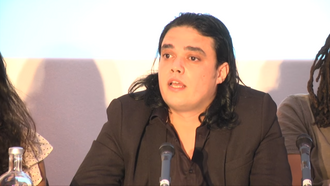
Waleed Al-Husseini
b. 1989 · Palestinian essayist and blogger, advocate of atheism and secularism
Waleed Al-Husseini (born 1989 in Qalqilya, West Bank) is a Palestinian essayist, writer and blogger best known for his atheism, his secularism and his defence of free expression in the Arab and Muslim world. His case became a reference point in debates over blasphemy laws in territories under the Palestinian Authority.
He studied computer science at university but never found steady work, and spent much of his time at an Internet café in his hometown. There he wrote on Facebook and on his blog, in Arabic and English, essays criticising Islam, parodying Quranic verses and mocking the life of the Prophet Muhammad. When his mother found articles on atheism on his computer and cut off his home internet, he simply moved his routine to the café.
In October 2010 Palestinian Authority intelligence had him watched for several weeks, and he was arrested as he sat in the café, accused of blasphemy. The arrest drew international attention, and human rights groups called for his release. He later said he had been tortured in prison. After about ten months he was freed on bail, yet he was detained several more times and his two computers were smashed. Fearing for his safety, he left for France, where he was granted asylum in 2012.
In France he founded the Council of Ex-Muslims of France in 2013 and became a public advocate of secularism. He argues that radical political Islam poses a threat to the secular French Republic, and he has criticised those he sees as downplaying that danger. In 2015 he published Blasphémateur! Les prisons d'Allah, an account of his imprisonment and his break with Islam.
His influence lies mainly in the debate over free expression, apostasy and secularism, both among Muslim communities in the diaspora and in the Middle East. His writing is more polemical than systematic, but it raises a question that remains open: how far should religious belief be shielded from public criticism?
Key ideas
- Secularism: the separation of religion from public power as a condition for everyone's freedom.
- Freedom of expression: the right to criticise or ridicule any belief, religious ones included, without it being a crime.
- Opposition to political Islamism: he distinguishes between believers and political projects that, in his view, threaten social coexistence and the secular Republic.
- The right to leave the faith: apostasy should bring neither legal punishment nor social rejection.
Works in Filopedia
Curiosities
A café as a refuge
According to the sources, he spent up to seven hours a day in a corner booth of an Internet café in Qalqilya. It was there, while sitting at a screen, that he was arrested.
An apology he says he did not write
In late 2010 a letter apologising for offending Muslims appeared on his blog. In his memoir he maintains that he did not write it and found it only after leaving prison.
Original Filopedia text based on Wikipedia (es) and Wikipedia (en) and Wikidata.