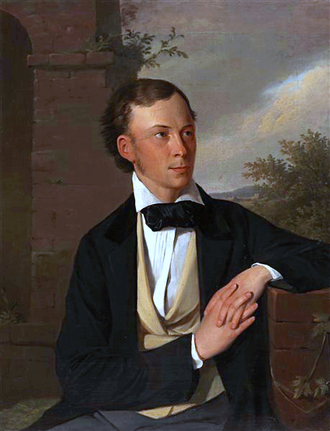
Władysław Syrokomla
1823–1862 · Polish-Lithuanian poet, prose writer and translator of the Romantic era
Władysław Syrokomla (born Ludwik Kondratowicz, 1823-1862) was a Polish-Lithuanian poet, prose writer and translator of the Romantic era. He wrote in Polish about the former Grand Duchy of Lithuania, then under the Russian Empire, and his work is valued today as a window onto the layered identities of that region.
Born on 29 September 1823 in a village in the Minsk Governorate, he came from an impoverished noble family. He left his studies at the Dominican school in Nyasvizh for financial reasons and worked on a farm estate and in the land office of the Radziwiłł family. In 1844 he published his first poem, Pocztylion, under a pen name taken from his family's coat of arms. He lived with little money for most of his life, and in 1852 three of his four children died.
Influenced by Adam Mickiewicz, he wrote ironic poems styled as eighteenth-century pastoral idylls and folk songs, and in his prose he backed peasant emancipation and the independence of the former Commonwealth. He translated Goethe, Heine, Lermontov, Shevchenko and Nekrasov, work regarded as a great service to the Polish language. He also wrote several poems in Belarusian, though many of them are believed to be lost.
In 1853 he settled in Vilnius, and in 1861 and 1862 he was one of the editors of the Kurier Wileński. After taking part in an anti-tsarist demonstration in Warsaw in 1861, he was arrested and sentenced to house arrest at his manor. He died in 1862 and was buried in the Rasos Cemetery in Vilnius.
His legacy is read today in terms of plural identity. Many sources call him a Polish poet, but Lithuanians remember him as a Lithuanian poet, and in Belarus his portrayals of rural life and his contribution to the language are praised.
Key works
- Pocztylion (1844): his first published poem, with which he made his name.
- Gawędy i rymy ulotne (1853): a collection of tales and rhymes in a familiar, everyday tone.
- Margier. Poemat z dziejów Litwy (1855): a poem drawn from the history of Lithuania.
- Janko Cmentarnik (1857): a poem named after its protagonist, a gravedigger.
Curiosities
A heraldic pen name
His literary name came from his family's coat of arms, which he used as the basis for the pen name he signed his first poems with.
A song by Tchaikovsky
The composer Tchaikovsky is said to have adapted one of his works, The Coral Beads, into a song.
Original Filopedia text based on Wikipedia (en) and Wikidata.