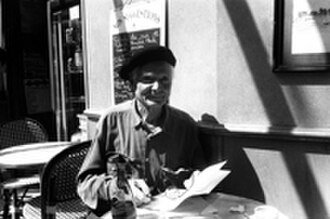
William Stanley Merwin (New York, 1927 - Haiku, Hawaii, 2019) was an American poet, translator and essayist, and one of the most influential voices in English-language poetry of the second half of the twentieth century. His work moves from the Vietnam era to myth, Buddhism and ecology, and his translations brought Spanish, Italian, Latin, Japanese and other literatures to English readers.
He grew up in New Jersey and Pennsylvania, the son of a Presbyterian minister, and as a child he wrote hymns for his father. He studied at Princeton, married in 1952 and lived in Spain, London and New York before settling in Hawaii in the late 1970s. His first book, A Mask for Janus, won the Yale Younger Poets prize, chosen by W. H. Auden.
His early poems drew on myth and legend, and many featured animals. In the 1960s his writing became more autobiographical and openly opposed to the war in Vietnam, and he is often grouped with the poets who responded to that conflict. In the 1980s and 1990s Buddhist philosophy and deep ecology shaped his work, which paired indirect narration with unpunctuated lines. He won the Pulitzer in 1971 but declined the prize in protest against the war, and received it again in 2009 for The Shadow of Sirius.
With his wife Paula, he helped found a nonprofit in Maui dedicated to restoring the rainforest on his property. His last book of poems, Garden Time (2016), was dictated to her after he lost most of his eyesight. His legacy lies in more than fifty books, in his English versions of Lorca and Neruda, and in his conviction that poetry is a form of close attention to the natural world.
Key works
- A Mask for Janus (1952), his first book, which won the Yale Younger Poets prize.
- The Lice (1967), a collection published during the Vietnam War.
- Migration: New and Selected Poems (2005), which won the National Book Award for Poetry.
- The Shadow of Sirius (2008), awarded the Pulitzer Prize for Poetry in 2009.
Curiosities
Childhood hymns
He started writing hymns for his father, a Presbyterian minister, at the age of five.
A declined Pulitzer
In 1971 he declined the Pulitzer Prize for Poetry for *The Carrier of Ladders* in protest against the Vietnam War.
Chosen by Auden
His first book won the Yale Younger Poets prize, judged by W. H. Auden.
Original Filopedia text based on Wikipedia (es) and Wikipedia (en) and Wikidata.