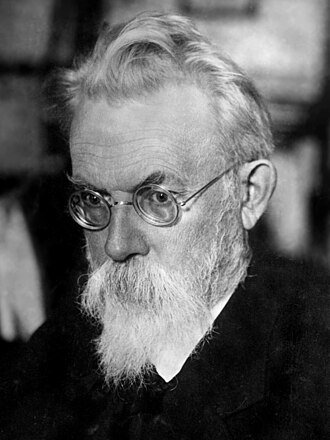
Vladimir Vernadsky
1863–1945 · Russian, Ukrainian and Soviet geochemist and mineralogist, pioneer of biogeochemistry and father of the noosphere concept
Vladimir Ivanovich Vernadsky (Saint Petersburg, 1863 – Moscow, 1945) was a scientist who worked across the Russian Empire, an independent Ukraine and the Soviet Union. He is regarded as one of the founders of geochemistry, biogeochemistry and radiogeology, and his ideas on the biosphere and the noosphere shaped Russian cosmism and modern environmental science. His work links mineralogy to the long history of life on the planet, which is why he is now studied both as a geologist and as an early thinker of the Earth as a system.
He graduated in physics and mathematics from Saint Petersburg University in 1885, with a thesis on isomorphous mixtures in minerals. After a period of study in several European countries, he began teaching mineralogy and crystallography at Moscow University in 1890 and received his doctorate there in 1897. As a pupil of Vasily Dokuchaev, the founder of soil science, he absorbed an integrated view of nature that would guide his later work. He became a member of the Russian Academy of Sciences in 1912 and in 1918 founded and presided over the Ukrainian Academy of Sciences, which is why Ukrainians and Russians both claim him as their own.
His best-known book, The Biosphere (1926), gave a precise scientific meaning to a term coined by Eduard Suess in 1875, and it was Vernadsky who made it widely known. For him, life was not a passive presence on the Earth's surface but a geological force that shapes the planet. He described the Earth as a layering of spheres: the lithosphere, the atmosphere, the biosphere, the technosphere, which is the transformation caused by humans, and the noosphere, the sphere of thought. He also argued that the composition of the atmosphere, with its oxygen, nitrogen and carbon dioxide, depends largely on biological processes, an insight that in some ways anticipated James Lovelock's Gaia hypothesis.
His influence was strongest in the Soviet Union, where he built a school of his own, while in the West his views were slow to win acceptance. His ideas reached English-speaking readers mainly through translations of Geochemistry (1924) and The Biosphere. Pierre Teilhard de Chardin took up the notion of the noosphere, and his legacy remains visible in ecology and in the study of the Earth as an integrated system.
Key ideas
- Biosphere: life as a geological force that transforms the Earth's surface and atmosphere.
- Noosphere: the sphere of human thought, the third stage in the planet's development after the geosphere and the biosphere.
- Three-stage evolution: Earth's history unfolds through geological, biological and cultural evolution.
- Atmosphere of biological origin: the composition of the air depends largely on the activity of living things.
- Systemic view of the Earth: life and geology must be studied together as a single system.
Curiosities
Stalin Prize
In 1943 he was awarded the Stalin Prize.
On Ukrainian banknote
His portrait appears on the Ukrainian 1,000 hryvnia banknote.
Original Filopedia text based on Wikipedia (es) and Wikipedia (en) and Wikidata.