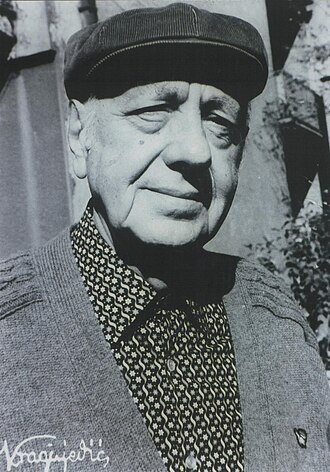
Vasile "Vasko" Popa was a Serbian poet of Romanian descent, born in 1922 in Grebenac, in the Vojvodina region, then part of the Kingdom of Yugoslavia, and died in Belgrade in 1991. He wrote in Serbian and is regarded as one of the most important poets of twentieth-century Yugoslavia and Serbia. His work has been widely translated, and he is among the most translated Serbian poets.
Born into a Banat Romanian family, Popa began writing at high school, and his first poems were in Romanian. After school he enrolled at the Faculty of Philosophy of the University of Belgrade and went on to study in Bucharest and Vienna. During the Second World War he fought as a partisan and was held in a German concentration camp at Bečkerek, today's Zrenjanin. After the war he graduated in Romance philology in Belgrade and began publishing in journals and in the newspaper Borba.
From 1954 to 1979 he edited the publishing house Nolit. His first major collection, Kora (Bark), appeared in 1953, the start of eight volumes of verse written over nearly four decades. His style is concise and modernist, drawing on surrealism and on Serbian oral tradition, including epic songs, riddles and tales. He worked colloquial speech and proverbs into his poems, blending the everyday with the mythical and the abstract with the concrete, in a manner far removed from the Socialist Realism that dominated Eastern European literature after the war.
Popa won several prizes, including the Branko Prize, of which he was the first recipient in 1954, and he was elected to the Serbian Academy of Sciences and Arts in 1972. Ted Hughes, who wrote the introduction to the English edition of his Collected Poems, admired him as a major poet, and his work continues to be read in Serbia and abroad.
Key works
- Kora (Bark, 1953), his first major collection.
- Sporedno nebo (Secondary Heaven, 1968), one of his best-known books.
- Uspravna zemlja (Earth Erect, 1972), in which his language becomes denser and more elliptical.
- Od zlata jabuka (The Golden Apple, 1958), an anthology of Serbian folk poetry that he selected himself.
Curiosities
First Branko Prize
In 1954 he became the first winner of the Branko Prize for poetry, named after the Serbian poet Branko Radičević.
A shared grave
A year after the death of his wife, Jovanka "Haša" Singer, her ashes were buried beside his remains at Belgrade's New Cemetery in 2001.
Original Filopedia text based on Wikipedia (es) and Wikipedia (en) and Wikidata.