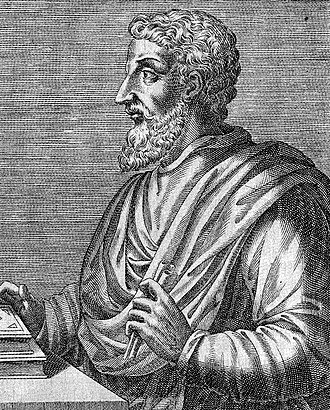
Marcus Terentius Varro
115 BC–26 BC · Roman polymath and scholar
Marcus Terentius Varro (116-27 BC) was a Roman polymath: a landowner of equestrian rank, soldier, public official and, above all, the greatest scholar of ancient Rome. Petrarch called him "the third great light of Rome", after Virgil and Cicero, and Quintilian described him as the most learned of the Romans. He belongs to the tradition of late Republican antiquarians and philologists, and his importance lies in his attempt to organise the whole of the knowledge of his time.
Born in Reate, modern Rieti, he kept his estates in the area for life. He held the offices of tribune of the plebs, quaestor and curule aedile, but never reached the consulship, probably because he publicly mocked the First Triumvirate. In the civil war of 49 BC he fought for Pompey, whose side was defeated. Julius Caesar pardoned him and placed him in charge of the first public library in Rome. After Caesar's murder, Mark Antony proscribed him and seized much of his property, including his books. Octavian later returned his estates. From then on Varro withdrew from public life and devoted himself almost entirely to study and writing.
His output was enormous: around seventy-odd works in several hundred books are attributed to him, and only one survives complete, the treatise On Agriculture, dedicated to his wife Fundania, which deals with running a farm. Six of the twenty-five books of his On the Latin Language survive. In that work he sets out a theory of how words are formed, draws the first distinction between inflection and derivation, and classifies the parts of speech by case and tense. His Nine Books of Disciplines, an encyclopedia of the liberal arts, became a model for later encyclopedists and helped shape the medieval idea of the seven liberal arts. He also wrote on Roman antiquities and religion, and Christian writers drew on him. In his agricultural treatise he warned against swamps, where he believed tiny invisible creatures could cause disease, an intuition about contagion that was far ahead of its time.
His influence lasted. His chronology of Roman history, carved on the arch of Augustus, became the standard accepted timeline, although it is now considered partly mistaken. Most of his lost works are known only through fragments quoted by later authors such as Aulus Gellius, and his way of ordering knowledge shaped European learning throughout the Middle Ages.
Key ideas
- Word formation: words arise from the need to name everyday things and actions, and new words are then built from them by derivation.
- Inflection and derivation: inflection (gender, number, case) is obligatory, whereas derivation, as in house and little house, is not.
- Parts of speech: Varro classifies them by case and tense, distinguishing noun, verb, participle and adverb.
- Liberal arts as ordered knowledge: his encyclopedia proposes nine disciplines as the basis of learning, a model for medieval education.
- Rational farming: running an estate should rest on observation and practice, including attention to the health of those who work on it.
Where to start
De re rustica is a dialogue-style treatise on farming and livestock written when Varro was around eighty years old. Its conversational form makes it accessible: readers will find practical advice on crops, animals and running an estate, along with a cultured Roman's view of the countryside as the foundation of social life.
Next: Antiquities of Human and Divine Things. The Antiquities of Human and Divine Things broadens the view to Rome's cultural, institutional and religious history, the vast erudition that made Varro famous.
Works in Filopedia
Books to read
- Roman Farm Management: The Treatises of Cato and Varro EnglishEPUB 295 KBRead online
Curiosities
A lost library
After Mark Antony proscribed him, he lost much of his property, including his library.
A three-headed monster
He mocked the First Triumvirate in a work whose title, according to Appian, was the Three-Headed Monster.
Original Filopedia text based on Wikipedia (es) and Wikipedia (en) and Wikidata.