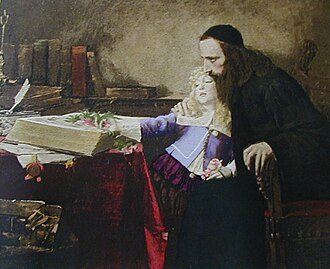
Uriel da Costa
1585–1640 · Portuguese Sephardi philosopher, critic of religious ritualism
Uriel da Costa (Porto, c. 1585 - Amsterdam, 1640) was a Portuguese philosopher of Sephardi origin who lived between the Catholic faith of his time and the Judaism of his family. He is often regarded as one of the earliest free thinkers of modern Jewish history, and his story anticipates many of the conflicts Spinoza would later face.
His family were New Christians, Jews who had been forcibly converted to Catholicism. He studied canon law at the University of Coimbra and held an ecclesiastical benefice, but while reading the Hebrew Bible he grew distant from Catholicism and drawn to Judaism. He left Portugal with his family, first for Hamburg and then for Amsterdam, where he took the Hebrew form of his name, Uriel.
In Amsterdam he wrote against the ritualism of the rabbis and argued that the Bible, and the Torah in particular, did not support the immortality of the soul, an idea he believed the Pharisees had introduced later. His book Examination of Pharisaic Traditions was publicly burned, and his views brought repeated excommunications. In 1640, after accepting a humiliating reconciliation that included lashes and being walked over by the congregation, he took his own life. His autobiography, Exemplar humanae vitae, was published in Latin decades after his death.
His central ideas concern religion as a human invention, a critique of empty ritual, and a case for a faith grounded in natural law. His influence came mostly after his death. Menéndez Pelayo made him known in Spanish, and Enlightenment thinkers such as Herder, Voltaire and Reimarus remembered him as a figure of reason and tolerance. It is thought that his ordeal moved Spinoza more than his writings did.
Key ideas
- Religion as human invention: da Costa held that religions are human creations and that true faith should rest on natural law.
- Critique of ritualism: he denounced mechanical ceremonies that, in his view, emptied rabbinic Judaism of spiritual content.
- Direct reading of the Bible: he argued that the Scriptures should be read without the mediation of later traditions.
- Mortality of the soul: he claimed that the immortality of the soul was not part of biblical Judaism but was added later by the Pharisees.
Curiosities
A misfired shot
According to Philipp van Limborch's account, da Costa first tried to shoot himself with a pistol, but it misfired. He then took another and fired it.
Thirty-nine lashes
He received 39 lashes, one less than the limit of 40 set by Jewish law.
Original Filopedia text based on Wikipedia (es) and Wikipedia (en) and Wikidata.