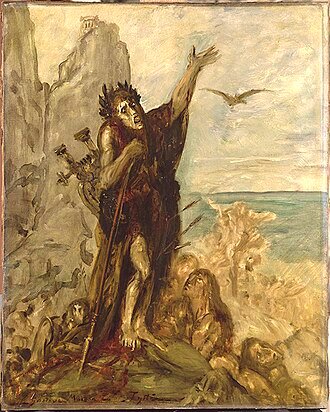
Tyrtaeus
700 BC–700 BC · Greek elegiac poet
Tyrtaeus was a Greek elegiac poet who was active probably in the middle or later part of the seventh century BC, and he is best known as the poet of Spartan war. He wrote in an Ionic dialect modeled on Homer, with a few Doric touches, and his importance lies in the way his verses helped shape Sparta's sense of itself during one of its most tense periods.
Little about his life can be established with certainty. Most of what survives comes from brief entries in the Suda, a Byzantine encyclopedia of the tenth century, and from later accounts that mix fact with legend. According to these stories, he was a lame Athenian schoolmaster of unattractive appearance, sent to Sparta by the Athenians as a kind of insult when the Spartans asked for a general. Modern scholars tend to see this tale as an invention, probably Athenian in origin, and they consider a Laconian birth more likely, given his occasional Doric vocabulary and the authoritative tone he takes with warriors.
His elegies, of which only fragments survive, address citizens during the Second Messenian War. Where Homer celebrated the deeds of the individual hero, Tyrtaeus praised collective courage, disciplined conduct in the hoplite line and obedience to the city. He argued that falling at the front was honourable, while fleeing or being wounded in the back brought shame. His poem Eunomia stressed a balance between kings, council of elders and the people, within an order presented as divinely sanctioned.
His legacy is debated. His songs were sung in camps and schools across Greece, and he came to be regarded as Sparta's national poet. Some modern scholars credit him with helping to push the city toward a harsh military way of life, while others doubt his influence was so great and point out that readings of his work often look backward from its later impact. Today he is remembered as one of the first poets to articulate the ideal of the citizen who sacrifices himself for the polis.
Key works
- Eunomia (Good Order): an elegy praising the Spartan constitution and urging concord among citizens.
- Exhortations (Hypothekai): calls to fight and to valour in keeping with the Dorian ideal of martial virtue.
- Marching Songs (Embateria): anapaestic verses meant to accompany military marches and exercises.
Curiosities
A poet of disputed origin
Ancient sources place him in Athens as well as in Sparta. Modern scholars often think the Athenian version was an invention meant to belittle Sparta.
An unflattering portrait
According to tradition he was lame and one-eyed, a detail a third-century AD writer attributes to him, though it is probably part of the legend.
Original Filopedia text based on Wikipedia (es) and Wikipedia (en) and Wikidata.