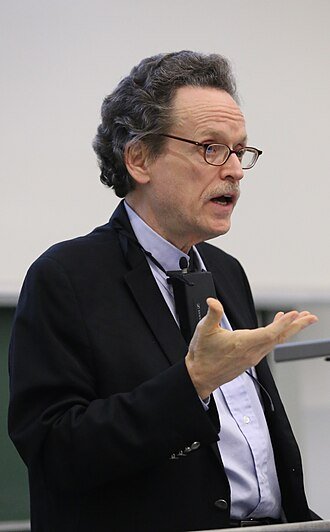
Thomas Pogge
b. 1953 · German political philosopher specializing in global justice
Thomas Pogge (born Hamburg, 1953) is a German philosopher working in the analytic tradition, best known for his work in political philosophy and global justice. His work connects John Rawls's theory of justice with the problem of world poverty, and it has shaped debates about what wealthy countries owe the poor.
He studied sociology in Hamburg and earned his doctorate at Harvard University in 1983 under the supervision of Rawls. He taught at Columbia University and has been at Yale since 2008, where he directs the Global Justice Program. His early work engaged with Rawls, Kant and cosmopolitanism.
His best-known book, World Poverty and Human Rights, argues that citizens of wealthy democracies harm the poor by supporting an unjust international order. Pogge criticizes the resource and borrowing privileges granted to illegitimate rulers, and he stresses institutional reform over individual charity. His influence can be seen in contemporary political philosophy and in effective altruism, although his work has also sparked considerable debate.
Key ideas
- Negative duties: wealthy people have a duty not to impose or uphold an unjust institutional order, and violating that duty helps cause poverty.
- Resource and borrowing privileges: international institutions facilitate the corruption of rulers and sustain absolute poverty.
- Global justice: Rawls's principles should be applied to the international sphere.
- Institutional reform: citizens fulfil their duties by working to change institutions, not only through individual gestures.
Original Filopedia text based on Wikipedia (es) and Wikipedia (en) and Wikidata.