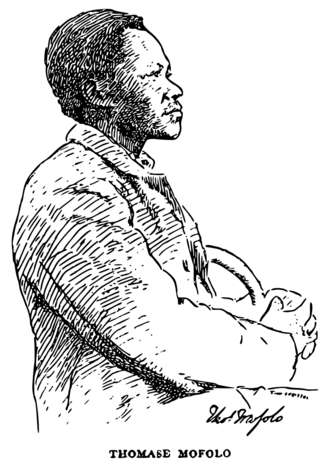
Thomas Mokopu Mofolo
1876–1948 · Basotho writer in the Sesotho language
Thomas Mofolo (Khojane, 1876 - Teyateyaneng, 1948) was a Basotho writer who worked in Sesotho, the language of Lesotho. He is often regarded as the first African novelist and the finest author to write a novel in an African language. His three books, composed between 1905 and 1910, first appeared in Sesotho and were later translated into many languages.
He grew up in Basutoland, a British colony, in a Protestant family, and was educated in schools run by the Paris Evangelical Missionary Society, an institution that shaped his writing career too. He worked at the Morija printing house, trained as a teacher and, in 1907, helped found a progressive association. His first two novels ran as serials in the mission newspaper Leselinyana: Moeti oa bochabela, an allegory that owes much to Bunyan, and Pitseng, a love story set in a Lesotho village. His third novel, Chaka, portrays the Zulu king as a tragic figure rather than a moral symbol, and missionary publishers delayed it for years, which is why he is thought to have given up writing. In 1910 he moved to Johannesburg to work as a labour recruiter, and he died in poverty in 1948. His legacy lives on in the Thomas Mofolo Library at the National University of Lesotho and in the Mofolo-Plomer Prize, created by Nadine Gordimer in 1976.
Key works
- Moeti oa bochabela (1907), often considered the first novel written in Sesotho, published in English as Traveller to the East: an allegory of a society in decline and the search for salvation.
- Pitseng (1910), a story of love and marriage set in a Lesotho village at the start of the twentieth century.
- Chaka (written 1909-1910, published 1925), a historical novel about the Zulu king and the difaqane, his best-known work.
Curiosities
A late English translation
The English version of Moeti oa bochabela, titled Traveller to the East, appeared in 1934 in a translation by Hugh Ashton. Later editions wrongly credit him as Harry Ashton.
Pitseng in English
Pitseng was published in Sesotho in 1910, but it did not appear in English until 2013, more than a century after its first edition.
Original Filopedia text based on Wikipedia (es) and Wikipedia (en) and Wikidata.