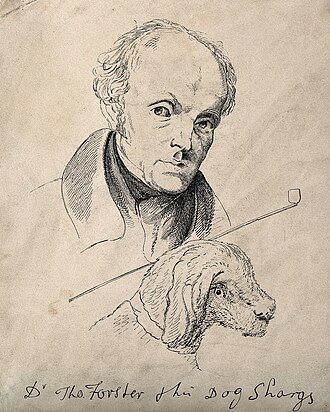
Thomas Ignatius Maria Forster
1789–1860 · English astronomer, physician and philosopher, early animal rights activist
Thomas Ignatius Maria Forster (London, 1789 - Brussels, 1860) was an English astronomer, physician, naturalist and philosopher. He is considered one of the earliest animal rights activists. He is best remembered for promoting vegetarianism and for coining the term "phrenology" in 1815.
He studied law at Cambridge before switching to medicine, qualifying in 1819. His interest in astronomy had been sparked by the Great Comet of 1811. Around 1806 he took up phrenology, studying the anatomy of the brain with Johann Spurzheim. In 1813 he published Physiological Reflections on the Destructive Operation of Spiritous and Fermented Liquors, where he argued for giving up meat and alcohol, drawing on Pythagorean ideas, cruelty to animals and Hindu practices. In 1833 he founded the Animals' Friend Society with Lewis Gompertz. Most of his later years were spent on the Continent, mainly in Bruges and Brussels, and he wrote on meteorology, cholera, poetry and morals. His Philozoia (1839) examines the moral condition of the animal kingdom and how it might be improved.
His influence can be seen in the early growth of animal welfare activism and in debates about diet. He is also said to have influenced Shelley's turn to vegetarianism, a link that shows the wide circle of intellectual contacts he kept.
Key ideas
- Vegetarianism and animal rights: cruelty to animals is a moral problem to be corrected, and a vegetarian diet is one way to do so.
- Phrenology: the idea that mental faculties are located in particular areas of the brain, a discipline he named.
- Climate and health: atmospheric conditions affect disease, especially cholera, according to his meteorological studies.
- Moral philosophy and Pythagoreanism: ethical reflection on how living beings are treated, inspired by Pythagorean tradition and the transmigration of the soul.
Curiosities
A comet of his own
On 3 July 1819 he discovered a new comet himself, about eight years after the Great Comet of 1811 had sparked his interest in astronomy.
Declining the Royal Society
In 1816 he turned down a fellowship of the Royal Society because he disliked some of its rules.
A balloon for studying the air
In April 1831 he made a balloon ascent as part of his research on atmospheric conditions and cholera.
Original Filopedia text based on Wikipedia (en) and Wikidata.