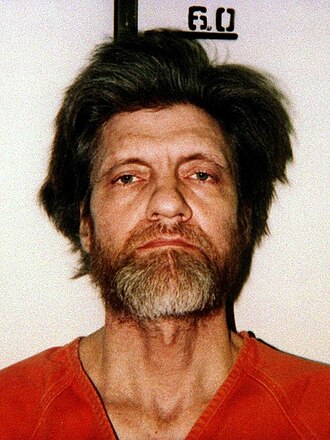
Ted Kaczynski
1942–2023 · American mathematician and anti-technology writer
Theodore John Kaczynski (Chicago, 1942 – Durham, 2023) is best known as the Unabomber, the author of a mail bombing campaign that killed three people and injured twenty-three between 1978 and 1995. His notoriety rests on those attacks, but he was also a thinker whose criticism of modern technology belongs to the neo-Luddite tradition, which distrusts technological progress and the industrial society it sustains. His case matters because it raises an uncomfortable question about how far technology shapes human freedom, and because his violence has never stopped dividing those who read his work.
He was born in 1942 into a family of Polish descent and showed exceptional intelligence from an early age. He skipped school grades, entered Harvard at sixteen, and after graduating in mathematics earned his doctorate at the University of Michigan in 1967. That year he began as an assistant professor at Berkeley, but he resigned in 1969. In 1971 he settled in a cabin without electricity or running water near Lincoln, Montana, where he lived in isolation, hunted, grew vegetables and taught himself to survive largely on his own.
From there he developed a critique of technology as something that eroded personal autonomy and damaged the natural world. In his view, technical progress built systems that demanded ever more adaptation from people, narrowing their room for choice. These ideas took shape in Industrial Society and Its Future, a manifesto of roughly 35,000 words published in 1995. It opposed technology in nearly all its forms, rejected leftist politics and called for a return to more primitive ways of life. Its proposal, however, moved toward violent revolution, which is where it parts company with most critics of technology, who have favoured reflection, politics or peaceful resistance.
The FBI investigation, known by the code name UNABOM, became one of the longest and most expensive in the bureau's history. In 1995 Kaczynski offered to stop his attacks if his manifesto were published, and it was his own brother, David, who recognised the writing style and alerted the authorities. He was arrested in 1996. To avoid the death penalty he agreed to plead guilty in 1998 and received several consecutive life sentences without parole.
His influence is now more debated than widespread. His manifesto is still cited in discussions about technology, the environment and the limits of progress, often as an example of a sharp diagnosis joined to an unacceptable conclusion. For the history of anti-technology thought he remains an uncomfortable figure, and for that very reason he continues to be studied.
Key ideas
- Critique of industrial society: technological development, he argued, reduced human autonomy and damaged the natural environment.
- Rejection of technology: he held that most technical innovations should be abandoned, not merely regulated.
- Cultural primitivism: he proposed a return to simpler ways of life, closer to nature and less dependent on complex systems.
- Revolution against the system: his manifesto concluded that change should be violent, a position most critics of technology reject.
Curiosities
Skipping a grade
After an IQ test scored at 167, he was allowed to skip sixth grade, an event he later regarded as decisive in his life.
Entering Harvard young
He entered Harvard at sixteen, having finished high school two years earlier than usual.
Teachers and influences
Influenced by
- Jacques Ellul 1912–1994
Original Filopedia text based on Wikipedia (es) and Wikipedia (en) and Wikidata.