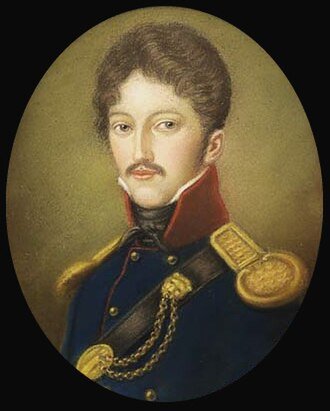
Theodor Körner (Dresden, 1791 – Wöbbelin, 1813) was a German poet and soldier from the Electorate of Saxony, who died at the age of twenty-one during the wars against Napoleon. He wrote in German, and his battle poems made him one of the emblems of patriotic feeling in his day, so much so that he came to be called the German Tyrtaeus.
The son of a consistorial councillor, he grew up in a cultured household. After finishing school he first considered a career in mining, but soon turned to literature. In Vienna, over roughly fifteen months, he wrote dramas, operas and farces, along with light comedies for the Burgtheater, which earned him the post of court poet. There he came to know Beethoven, for whom he began a libretto he never finished, and he became engaged to the actress Antonie Adamberger.
In 1813 he left Vienna and joined the Lützow Free Corps, a volunteer unit fighting the French. His songs and war poems, including the Schwertlied, lifted the spirits of his comrades, and several were set to music by Weber and Schubert. Badly wounded in the head during a clash near Kitzen, he hid in a forest, where he wrote the sonnet Abschied vom Leben. He recovered and rejoined his unit in Mecklenburg.
He died on 26 August 1813 in the forest of Rosenow, hit by a shot to the abdomen. His early work, light and theatrical, has been largely overshadowed by his war poetry, which his father gathered after his death. His reputation endured in music and in the memory of German nationalism, and the Italian poet Alessandro Manzoni dedicated his ode Marzo 1821 to him.
Key works
- Knospen (1810), his first volume of poems.
- Der grüne Domino (1812), a light comedy that was very successful in its day.
- Die Braut (1812), another popular light comedy.
- Leier und Schwert (1814, posthumous), a selection of his battle songs assembled by his father.
Curiosities
A sonnet written while wounded
According to the sources, he composed the sonnet Abschied vom Leben while hiding in a forest with a serious head wound, expecting that he might not survive.
A sister who followed him
His sister Emma, who was very close to him, died two years later in Dresden and was buried beside his grave in Wöbbelin.
Original Filopedia text based on Wikipedia (en) and Wikidata.