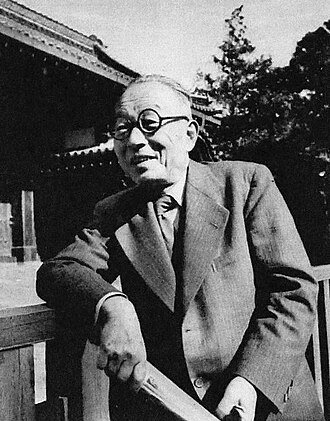
Tetsuro Watsuji
1889–1960 · Japanese moral philosopher and historian
Tetsuro Watsuji (Himeji, 1889 – 1960) was a Japanese moral philosopher and historian, one of the most important ethical thinkers in twentieth-century Japan. His work set out to understand ethics through the relationship between people and their environment, rather than through the isolated individual of Western tradition.
The son of a physician, he loved poetry and Western literature as a young man, and his philosophical vocation took shape while he was a student at the First Higher School in Tokyo. In his early essays, written between 1913 and 1915, he introduced Kierkegaard to Japan and worked on Nietzsche, but in 1918 he turned against Western individualism and began studying the roots of Japanese culture, from Buddhist art to the Zen teachings of Dōgen. He joined Kyoto Imperial University in 1925 and spent 1927 and 1928 in Europe, where he read Heidegger.
His most distinctive idea appears in Climate (Fūdo, 1935), where he argues that climate and environment shape human life and culture, distinguishing pastoral, desert and monsoon cultures. His three-volume Ethics, published between 1937 and 1949, describes the human being as a social creature whose existence is fundamentally relational. During the Second World War, some of his claims about the superiority of Japanese sensibility were used to support nationalism, a matter he later said he regretted. His influence extends across later Japanese philosophy and debates about culture and environment.
Key ideas
- Ningen (human betweenness): people exist always in relation to others, and ethics is the study of that relationship.
- Environmental influence: climate and natural setting shape the ways of life and culture of each people.
- Critique of individualism: the Western tradition of the isolated self cannot fully explain Japanese moral life.
- Cultural roots: the study of Japanese art, religion and history is essential to understanding its ethical thought.
Teachers and influences
Teachers
- Natsume Sōseki 1867–1916
Influenced by
- Georg Wilhelm Friedrich Hegel 1770–1831
- Martin Heidegger 1889–1976
- Kitarō Nishida 1870–1945
Original Filopedia text based on Wikipedia (en) and Wikidata.