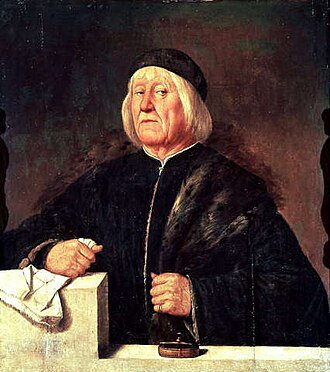
Teofilo Folengo
1491–1544 · humanist writer and Benedictine monk
Teofilo Folengo (Mantua, 1491 - Bassano del Grappa, 1544) was an Italian humanist writer and Benedictine monk, and one of the leading practitioners of macaronic verse, a style that mixes Latin with Italian dialects. Born Gerolamo, he took the name Teofilo when he entered the Benedictine order. He wrote under several pseudonyms, and his sharp, irreverent humour makes him a distinctive figure of the Italian Renaissance.
The son of a notary from Mantua, he was the eighth of nine children. Some scholars argue that he was really born in 1496. After studying in Bologna, he spent years in monasteries in the Veneto, until disputes with his abbot led him to give up the habit in 1524. He then worked as a private tutor and settled in Venice. In 1534 he was readmitted to the order and moved to a monastery in Sicily. He returned to the mainland in 1543 and retired to Campese, near Bassano del Grappa, where he died the following year.
His largest work, the Maccheronee, appeared in several versions between 1517 and 1552, the last one posthumously. He revived macaronic writing, a playful form from Padua, and turned it into a serious literary tool. His language blends classical Latin with dialect vocabulary to offer an unconventional view of the society of his day. The Baldus, his most famous poem, parodies chivalric romances and the epics of Pulci and Boiardo, and also Virgil and, in its final part, Dante.
His influence was real: the Baldus left a mark on François Rabelais, and his Moscheide served as a model for the Spanish mock-epic Mosqueida by José de Villaviciosa. Today he is remembered mainly as one of the great names of macaronic poetry.
Key works
- Baldus (1517): a macaronic poem that parodies chivalric romances and Italian heroic verse.
- Orlandino (1526): an octave poem recounting the childhood and youth of Roland.
- Caos del triperuno (1527): an autobiographical work mixing prose and verse, Latin and Italian, about his life under different names.
- L'Umanità del Figliuolo di Dio (c. 1533): a life of Christ in rhymed octaves.
Works in Filopedia
Curiosities
Many names
He published under pseudonyms such as Limerno Pitocco, meaning 'Merlin the Beggar', and Merlinus Cocaius.
A wandering life
Around 1516 he left monastic life and travelled through the countryside for several years with a young noblewoman, Girolama Dieda, often living in poverty and relying on his gift for writing.
Original Filopedia text based on Wikipedia (es) and Wikipedia (en) and Wikidata.