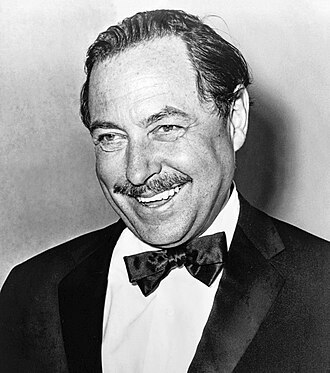
Thomas Lanier "Tennessee" Williams III was born in Columbus, Mississippi, in 1911 and died in New York City in 1983. Together with Eugene O'Neill and Arthur Miller, he is usually counted among the three most important American dramatists of the twentieth century. His importance lies in putting outsiders and troubled Southern families at the center of the stage, blending realism with dream and fantasy.
His childhood was unsettled. His father, a traveling shoe salesman, grew more volatile as the years passed; his mother, Edwina, came from a respectable Southern family and encouraged his reading and writing. A bout of diphtheria left him frail and kept him indoors for long stretches. Around the age of thirteen his mother gave him a typewriter. At sixteen he won a small prize for an essay in Smart Set, and a year later a short story of his appeared in Weird Tales. At the University of Missouri, fraternity brothers gave him the nickname Tennessee, a nod to his drawl. He then took a factory job, suffered a nervous breakdown, and moved to New Orleans, where he worked for the WPA and lived in the French Quarter.
His breakthrough came with The Glass Menagerie, staged in New York in 1945, a memory play drawn from his own mother and sister. Two years later A Streetcar Named Desire, directed by Elia Kazan, made him famous and earned the Pulitzer Prize in 1948. Cat on a Hot Tin Roof won a second Pulitzer in 1955. Success allowed him to travel with his partner, Frank Merlo, and to keep moving between cities, from New Orleans and New York to Key West, Rome, and London.
His characters are often faded aristocrats, fragile young women, sensitive artists, and aggressive men, all pressed against a society that rewards pretense. Critics frequently see his family in them: Laura Wingfield and Blanche DuBois are read as echoes of his sister Rose, and Amanda Wingfield of his mother. Rose's prefrontal lobotomy in 1943, authorized by their parents, went badly and left her disabled for life. Williams never forgave his parents, and some biographers link the episode to his drinking. His work also shows debts to Southern Gothic writing and to Chekhov, Strindberg, Lawrence, and Hart Crane.
He died in 1983 in a hotel suite in Manhattan. The medical examiner's report said he choked on the cap of an eye-drop bottle he often used, and drugs and alcohol were thought to have contributed by suppressing his gag reflex. He was buried in St. Louis, Missouri, though he had wanted to be buried by the sea. His legacy includes many film adaptations, directed by figures such as Kazan, Mankiewicz, Huston, and Brooks, and a long run of Broadway productions.
Key works
- The Glass Menagerie (1945): a fragile young woman and her overbearing family in St. Louis, drawn from the author's own household.
- A Streetcar Named Desire (1947): Blanche DuBois arrives at her sister's New Orleans apartment, and her illusions collide with Stanley Kowalski's brutality.
- Cat on a Hot Tin Roof (1955): a Mississippi family gathers around a dying patriarch, and lies, desire, and inheritance clash.
- Sweet Bird of Youth (1959): a faded actor and his aging companion return to a Gulf Coast town where the past catches up with them.
Curiosities
A fraternity nickname
His fraternity brothers at the University of Missouri gave him the nickname Tennessee because of his strong Southern accent. He later adopted it as his professional name.
A typewriter at thirteen
After a long recovery from diphtheria, his mother gave him a typewriter when he was about thirteen, a gift that marked the start of his literary vocation.
Jury president at Cannes
In 1976 he served as president of the jury at the Cannes Film Festival, a sign of his standing in film and theatre.
Teachers and influences
Influenced by
- Anton Chekhov 1860–1904
- August Strindberg 1849–1912
- D. H. Lawrence 1885–1930
Original Filopedia text based on Wikipedia (es) and Wikipedia (en) and Wikidata.