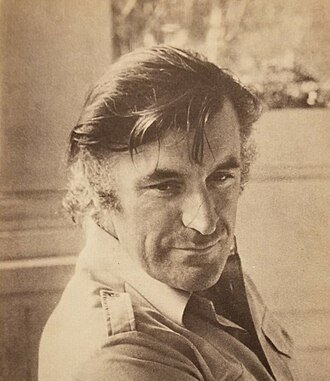
Edward James Hughes, known as Ted Hughes (Mytholmroyd, 1930 – London, 1998), was an English poet and writer for children. Critics often rank him among the best poets of his generation, and in 1984 he was appointed Poet Laureate, a post he held until his death. His name is also closely linked to that of the American poet Sylvia Plath, whom he married in 1956, and their relationship remains a subject of debate.
He grew up in the Calder Valley of the West Riding of Yorkshire, among farms and moorland. His father, a joiner, had fought at Ypres and came through the war by a narrow margin: a bullet lodged in the account book he carried in his breast pocket. As a boy Hughes loved animals, hunting, fishing and drawing. When his family moved to Mexborough in South Yorkshire, his teachers encouraged him to write and introduced him to Hopkins and Eliot. During his national service in the RAF he read and reread Shakespeare and memorised much of Yeats.
At Cambridge he switched from English to anthropology and archaeology, subjects he later said shaped his poetry, though he was not an outstanding student. He held a string of very different jobs, from rose gardener to reader for a film company, and worked at London Zoo, where he could watch animals at close range. In 1956 he met Plath at a party, and they married that same year. His first major book, The Hawk in the Rain (1957), brought him wide critical acclaim. His style, built on hard trochees and spondees and an echo of Middle English, stood apart from the more genteel, Latinate diction of his day.
After returning to England in 1959 he published Lupercal (1960), which won the Hawthornden Prize. He was soon labelled a poet of the wild, yet he was also drawn to myth and esoteric traditions, from shamanism to Buddhism. The couple had two children, separated in 1962, and Plath died by suicide in 1963. His work and his public image drew controversy, in part because of disputes with feminists and with American admirers of Plath. His last collection, Birthday Letters (1998), looks back at the marriage without setting out directly the circumstances of her death. In 2008 The Times placed him fourth on its list of the 50 greatest British writers since 1945, and in 2010 a memorial in Poets' Corner at Westminster Abbey was announced.
Key works
- The Hawk in the Rain (1957): his first major book, which earned wide critical praise and a Somerset Maugham Award.
- Lupercal (1960): a collection linked to his animal poems, which won the Hawthornden Prize.
- Crow: a sequence of mythic, harsh poems, illustrated by Leonard Baskin.
- Birthday Letters (1998): his final collection, a reflection on his marriage to Plath.
Curiosities
A wedding on Bloomsday
The couple chose 16 June 1956 for their wedding, known as Bloomsday, in honour of the writer James Joyce.
A bullet in the notebook
According to the family account, a bullet that could have killed his father at Ypres lodged in the account book he carried in his breast pocket.
Teachers and influences
Influenced by
- Arthur Schopenhauer 1788–1860
- William Blake 1757–1827
- T. S. Eliot 1888–1965
- Czesław Miłosz 1911–2004
- John Donne 1572–1631
- Robert Graves 1895–1985
- Gerard Manley Hopkins 1844–1889
Original Filopedia text based on Wikipedia (es) and Wikipedia (en) and Wikidata.