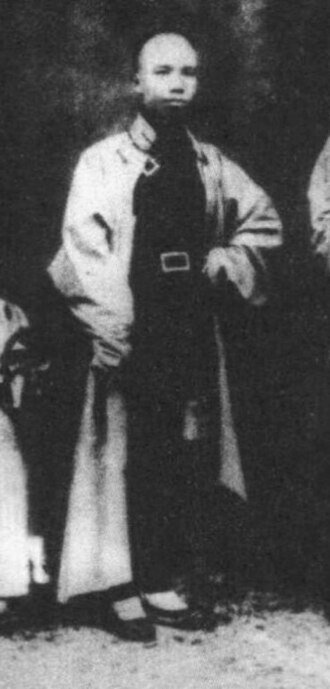
Tan Sitong
1865–1898 · Chinese reformist thinker and politician of the late Qing dynasty
Tan Sitong (1865-1898) was a reformist thinker and politician in the final period of the Qing dynasty. He is a key figure for understanding the failure of the Hundred Days' Reform of 1898. He was one of six men executed after that episode, and his death at thirty-three later became a symbol of the reformers' sincerity and of the regime's crisis.
He was born in Beijing, though his family came from Liuyang in Hunan Province. His father was a senior official. After his mother and two siblings died of diphtheria, his education took an unconventional path: he objected to the rigid essay form required by the imperial examinations and reached only the lowest degree. In 1884 he travelled through many Chinese provinces and wrote more than two hundred poems on the journey.
China's defeat by Japan in 1895 and the humiliating Treaty of Shimonoseki convinced him that deep reform was necessary. He wrote Ren Xue (Theory of Benevolence), usually considered one of the first philosophical works of the reform movement, and founded an academy and a newspaper in Hunan to spread its ideas. Unlike Kang Youwei and Liang Qichao, who favoured a reformed monarchy, he proposed a republic as the answer to China's subjugation by Western powers and Japan, and he placed nationalism above loyalty to the dynasty. Yet he remained rooted in Confucian thought, and he developed a view of goodness that joined ethical concern for society, present and future, with constant personal effort at self-cultivation.
In 1898 he joined the circle around Emperor Guangxu and became the highest-ranking official involved in the reforms. The opposition of the Empress Dowager Cixi led to a coup that reversed almost all the decrees and placed the emperor under confinement. Tan attempted a plan to curb Cixi, but it failed. He could have fled to the Japanese legation with Liang, but he chose to stay, was arrested, condemned, and beheaded in Beijing on 28 September 1898. His last words, as traditionally reported, expressed both his powerlessness and his readiness to die with dignity.
His influence outlasted him. For many contemporaries, his execution showed that the dynasty could not reform itself from within, and it helped push part of the intellectual class toward the violent revolution that would end Qing rule.
Key ideas
- Republic over reformed monarchy: Tan argued that only a change of regime could free China from foreign domination.
- Nationalism: He placed loyalty to the Chinese nation above loyalty to the ruling dynasty.
- Social ethics and self-cultivation: Goodness meant ethical sensitivity to society, present and future, joined to personal effort at self-improvement.
- Reinterpreted Confucian tradition: Despite his political radicalism, he kept the ethical core of Confucianism and put it at the service of reform.
- Critique of absolute monarchy: In Ren Xue he argued that absolute power oppressed human nature.
Curiosities
A chosen death
He could have fled to Japan with Liang Qichao, but chose to stay, convinced that his sacrifice might inspire the reform cause.
Last words
According to tradition, before his death he said he was eager to kill the oppressors but powerless to turn the tide.
Original Filopedia text based on Wikipedia (es) and Wikipedia (en) and Wikidata.