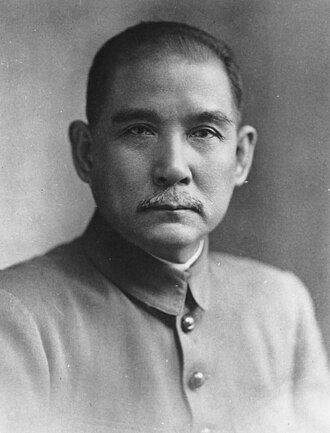
Sun Yat-sen
1866–1925 · Chinese physician, revolutionary and political thinker, founder of the Kuomintang
Sun Yat-sen (1866–1925) was a Chinese physician, revolutionary and political thinker who played a decisive role in ending the Qing dynasty and moving China toward a republic. He founded the Kuomintang and served as the first provisional president of the Republic of China in 1912. Today he is regarded in Taiwan and in the People's Republic of China as the father of modern China, although his image and legacy have been contested ever since his death.
He was born in 1866 in the village of Cuiheng, in Guangdong province, into a poor peasant family of Hakka background. His elder brother took him to Hawaii, where he received an English-language education in mission schools. After a short return to his home village, he settled in Hong Kong, converted to Christianity and trained in medicine, qualifying in 1892 at the city's medical college for Chinese students. The training stayed with him, but politics would become his real vocation.
In 1894 he wrote a lengthy memorial proposing ways to modernize China and travelled to Tianjin to present it to the viceroy Li Hongzhang, who never granted him an audience. That rejection pushed him away from reform through the existing system and towards revolution. In Hawaii he founded the Revive China Society, often regarded as the first Chinese nationalist revolutionary organization, and in 1905 he created the Tongmenghui, which aimed to end Manchu rule and establish a republic. His uprisings repeatedly failed, and he spent long periods in exile in Japan and elsewhere in Southeast Asia.
The 1911 Revolution brought down the imperial system. Sun was chosen provisional president in 1912, but he handed the office to the veteran general Yuan Shikai in return for the abdication of the court. After the assassination of Song Jiaoren in 1913, widely blamed on Yuan, Sun launched a failed second revolt against him and went back into exile. From Guangzhou he led rival governments that won no international recognition and fought the northern warlord camps, but a 1922 campaign against the northern government ended with his expulsion from the city.
His political thought is usually summed up in the Three Principles of the People, a programme for modernizing China. The first was nationalism, meaning the assertion of China against foreign powers and the peaceful coexistence of the peoples within it. The second was democracy, understood as a republican system with active citizen participation. The third was the livelihood of the people, meaning economic well-being for ordinary citizens. It was less a closed theory than an action programme, and historians still debate how far it was carried out.
His influence has lasted. Both the Kuomintang and the Chinese Communist Party claim him, though with different titles: in Taiwan he is called Father of the Nation, while in the People's Republic he is known as the Forerunner of the Revolution. He died in Beijing in 1925 while still trying to build support for a national assembly and the abolition of the unequal treaties.
Key ideas
- Nationalism: the liberation of China from foreign powers and the harmonious union of the different peoples who make up the nation.
- Democracy: replacing monarchy with a republican system in which citizens take part in government.
- People's livelihood: improving the material and economic well-being of the population as the central goal of modernization.
Books to read
- The International Development of China EnglishEPUB 211 KBRead online
Curiosities
A name adopted in exile
When he arrived in Japan in 1897 and registered at a hotel under a hidden identity, a friend wrote down the Japanese surname Nakayama for him. The name, rendered as Zhongshan, became the one by which he is best known in the Chinese-speaking world.
A name shaped by Cantonese
His schoolroom name Yixian and his earlier art name Rixin sound different in Mandarin but identical in Cantonese. It was the Cantonese form Yat-sen that spread in the West, which is why he is known abroad by that name.
Original Filopedia text based on Wikipedia (es) and Wikipedia (en) and Wikidata.