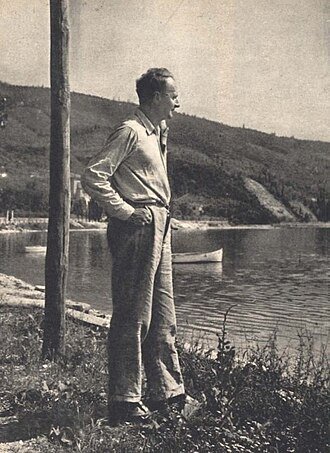
Stephen Spender
1909–1995 · English poet, novelist and essayist
Stephen Spender (London, 1909 – London, 1995) was an English poet, novelist and essayist whose work dealt with social injustice and the class struggle. He belonged to a generation of Oxford writers who, in the 1930s, turned to poetry as a way of responding to the economic slump and the rise of fascism in Europe.
The son of the journalist and liberal writer Harold Spender, he moved through several schools before reaching Oxford, which he left without a degree. He was close to W. H. Auden, who brought him into the circle around Christopher Isherwood. In 1929 he settled in Hamburg and then in Berlin, where he saw the Nazi rise at first hand. That experience shaped his early verse, which carried a strong social and political charge and quickly made his name.
In 1936 he joined the Communist Party of Great Britain and the following year went to Spain as a correspondent for the Daily Worker during the civil war. His disillusion with communism grew after the Nazi-Soviet pact of 1939, and by 1949 he had contributed to the collection The God that Failed, in which he set out his break with the party. During the Second World War he served as a volunteer with the London fire service.
With Cyril Connolly and Peter Watson he founded the magazine Horizon, and he later edited Encounter until 1966, when he resigned after it emerged that the magazine had been funded by the CIA. He taught at American universities and was named Poet Laureate Consultant in Poetry to the Library of Congress in 1965. He later held a professorship of English at University College London.
His reputation rests chiefly on the poetry of the 1930s, which is still read as a record of its time, and on his work as an editor and promoter of postwar European literary life.
Key works
- Twenty Poems (1930), an early collection from his youth.
- Vienna (1934), a long poem in praise of the 1934 uprising of Austrian socialists.
- Trial of a Judge (1938), an antifascist verse drama.
- The Still Centre (1939), a collection from the period just before the war.
- Collected Poems, 1928-1953 (1955), a gathering of his poetry up to that date.
Curiosities
A poet in the fire service
During the war he volunteered with the London fire service. He was first graded unfit for full service, but he pressed for a second examination and was upgraded.
A resignation over CIA funding
He left the editorship of Encounter in 1966, after it emerged that the Congress for Cultural Freedom, which published it, had received covert CIA funding. He insisted he had not known the true source of the money.
Original Filopedia text based on Wikipedia (es) and Wikipedia (en) and Wikidata.