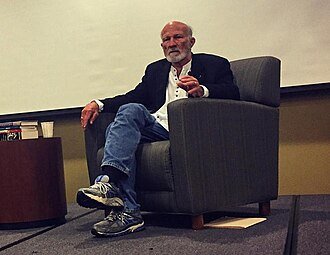
Stanley Hauerwas
b. 1940 · American theologian and ethicist, a central figure of postliberal theology
Stanley Hauerwas (born in Dallas, Texas, on July 24, 1940) is an American theologian, ethicist and public intellectual. Raised in a working-class family in the Methodist tradition, he worked as a bricklayer under his father as a young man, an experience he often returns to when describing the discipline of theological work.
He studied at the Methodist Southwestern University and then at Yale, where he earned his doctorate in philosophy. He taught at Augustana College and then at the University of Notre Dame, before joining the Divinity School at Duke University in 1983, from which he retired in 2013. In 2014 he took up a chair in theological ethics at the University of Aberdeen.
His thought holds that Christian ethics is not the application of universal principles but belonging to a community shaped by a story. For Hauerwas, the church's first task is to be itself, a people with its own narrative, rather than to improve the world from outside. From this premise he challenges liberalism, capitalism and militarism, while keeping his distance from both Christian fundamentalism and liberal Christianity. Resident Aliens, written with William Willimon, is probably his best-known book.
His influence reaches scholars of political philosophy, sociology and literary theory, as well as readers far beyond religious circles.
Key ideas
- Narrative: Christian convictions and any social ethic depend on a story that gives meaning to the life of the community.
- Virtue ethics: moral character is formed through practices and habits within a community rather than through abstract rules.
- Church as polis: the Christian community is a political alternative to every nation, not a moral support for the liberal state.
- Critique of liberalism: Christians have too readily accepted liberal democracy and capitalism as a social strategy.
- Postliberal theology: theological truth is understood through the practices and language of faith rather than neutral philosophical foundations.
Curiosities
A bricklayer by trade
As a young man he learned bricklaying under his father, an experience he has often compared with his way of doing theology.
A disputed 'best theologian'
In 2001 Time magazine named him "America's Best Theologian", but he replied that "best" is not a theological category.
Original Filopedia text based on Wikipedia (es) and Wikipedia (en) and Wikidata.