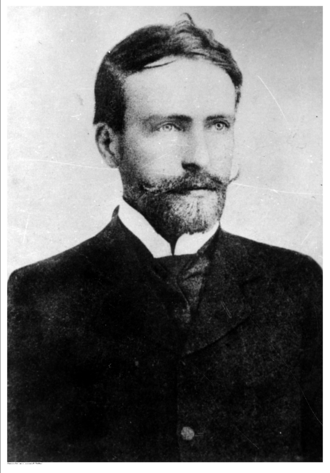
Stanisław Wyspiański
1869–1907 · Polish painter, playwright and designer
Stanisław Wyspiański (Kraków, 1869 – Kraków, 1907) was a Polish artist who worked across many forms: playwright, painter, poet, and designer of interiors and furniture. Writing in Polish during the partitions, when Poland did not exist as a state, he became one of the most prominent cultural figures of his country. His work joined modernism with traditional Polish folk and Romantic themes, and he is sometimes called the fourth Polish bard, after Mickiewicz, Słowacki and Krasiński.
He was the son of the sculptor Franciszek Wyspiański and Maria Rogowska, who died of tuberculosis in 1876. His father struggled with alcohol, and Wyspiański was raised by his aunt Joanna Stankiewiczowa and her husband in a bourgeois intellectual household. There he met the painter Jan Matejko, who recognised his talent. He enrolled at the Jagiellonian University and the Kraków School of Fine Arts in 1887. Between 1890 and 1895 he travelled through Italy, Switzerland, Germany, Prague and France, where he met Paul Gauguin.
Back in Kraków he worked on paintings, stained glass, furniture and stage design, and joined the Young Poland movement. His stained glass for the Franciscan church remains a key example of the period. His play The Wedding (1901), based on a wedding he attended, is a sarcastic portrait of Polish society that made him a national dramatist. He followed it with plays on Polish history and translated Corneille and Voltaire. His Study on Hamlet (1905) is his only essay and is still widely read.
He died of syphilis in 1907, aged thirty-eight. His influence on Polish theatre lasted through the twentieth century, with productions by Grotowski, Wajda and Kantor drawing on his ideas, and he remains a central figure in Polish art and letters.
Key works
- Warszawianka (1898), a play on national history that brought him his first success.
- The Wedding (Wesele, 1901), a satire of Polish society that established him as a major dramatist.
- Liberation (Wyzwolenie, 1903), a drama on Polish national history.
- Acropolis (1904), a play on the history of Poland.
- Study on Hamlet (1905), his only essay, full of theatrical ideas.
Curiosities
A real wedding
*The Wedding* grew out of a 1900 wedding Wyspiański attended in Bronowice, near Kraków. The play draws on the guests and tensions of that celebration.
A family portraitist
He often drew his children in everyday scenes such as sleeping or eating, using soft pastel.
Original Filopedia text based on Wikipedia (es) and Wikipedia (en) and Wikidata.