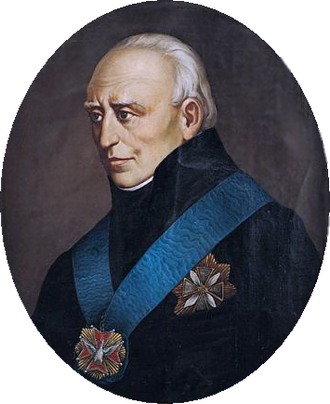
Stanisław Staszic
1755–1826 · Polish Enlightenment philosopher, geologist and statesman
Stanisław Staszic (Piła, 1755 – Warsaw, 1826) was the leading figure of the Polish Enlightenment. A Catholic priest, philosopher, geologist, poet, translator and politician, he worked at a time when Poland had lost its independence after the partitions. He is considered one of the fathers of Polish geology and one of the intellectual inspirers of the Constitution of 3 May 1791.
He was born into a burgher family in Piła and was the youngest of four siblings. He studied at Wałcz and graduated from a Jesuit school in Poznań in 1778, the year he was ordained a priest. Between 1779 and 1781 he continued his education in Paris at the Collège de France, where he developed an interest in physics and natural history. Back in Poland he became tutor in the household of Chancellor Andrzej Zamoyski, which drew him into the political life of the time. In 1782 he received his doctorate from the Zamojski Academy, where he also taught French.
His breakthrough came in 1787 with Remarks upon the Life of Jan Zamoyski, published anonymously on the eve of the Great Sejm. Presented as a biography, the book argued for reform and showed that many of the proposals had already been made by Zamoyski two centuries earlier. It was a huge success and set off a flood of political writing. Warnings for Poland (1790) followed, criticising the magnates, monastic orders and serfdom, and calling for a wider political franchise. In theory Staszic preferred republicanism, but he came to accept a stronger royal power as the practical route to modernisation.
After the failure of the Kościuszko Uprising in 1794 and the collapse of the Commonwealth, he turned to science and public administration. He co-founded the Warsaw Society of Friends of Learning in 1800 and presided over it from 1808; it became the forerunner of the Polish Academy of Sciences, and its headquarters is known as the Staszic Palace. In the Duchy of Warsaw he worked on education, and in Congress Poland he held government posts linked to education and industry. He promoted mining, metallurgy and transport infrastructure, and his work led to the discovery of coal deposits at Dąbrowa Górnicza. His most ambitious philosophical work, Humankind (1820), was largely withdrawn under the new censorship law, and his claims for the primacy of science and his criticism of religious influence won him both admirers and critics.
His legacy reaches geology, sociology and the study of the Tatra Mountains, and some of his ideas are seen as early anticipations of evolutionism. He died in Warsaw in 1826, probably of a stroke.
Key ideas
- Enlightenment and reform: reason and science should guide the transformation of the state, and reform must include the lower classes.
- Physiocracy and economic freedom: land and labour are the basis of wealth, and economic activity should face few obstacles.
- Monism: nature and humanity form a single reality that science can explain without a sharp split between mind and matter.
- The primacy of science: scientific knowledge should guide public life and education, with a critical stance towards religious influence.
- Pan-Slavism: after 1815 he argued for cooperation with the Slavic world, and especially with Russia, as a guarantee for Poland.
Curiosities
An anonymous book that changed his fortune
His first major political work appeared unsigned in 1787, and it turned a little-known tutor into one of the most listened-to political voices of his day.
A palace named after him
The headquarters of the scientific society he helped found in Warsaw is known as the Staszic Palace.
Original Filopedia text based on Wikipedia (es) and Wikipedia (en) and Wikidata.