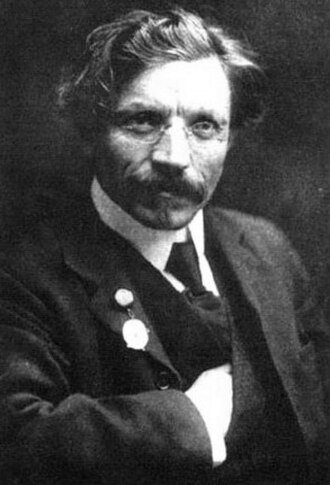
Sholem Aleichem
1859–1916 · Yiddish-language Jewish writer
Sholem Aleichem (born Solomon Rabinovich in Pereiaslav, Russian Empire, in 1859; died in New York in 1916) was a Jewish writer who worked mainly in Yiddish, a language many of his contemporaries dismissed as mere "jargon." A novelist, short-story writer and playwright, he became the central figure of Yiddish literature in the late nineteenth and early twentieth centuries. His work captures the life of small Jewish towns in Eastern Europe, known as shtetls, and he argued that a vernacular language deserved the same respect as any modern European tongue.
His family fell from prosperity into hardship after a failed business venture, and his mother died during a cholera epidemic when he was thirteen. He began writing as a teenager, and his pen name comes from the Yiddish greeting "shalom aleichem," meaning "peace be upon you." He worked as a tutor and in 1883 married Olga, with whom he had several children. He first wrote in Russian and Hebrew, but from 1883 he turned to Yiddish and eventually produced more than forty volumes in it. He also spent his own money to support younger writers through the almanac Die Yiddishe Folksbibliotek. In 1890 he lost his fortune in a stock-market speculation, and the almanac's third issue was never printed. Around this time he contracted tuberculosis. He lived in Odessa and Kiev, and after the pogroms of 1905 he traveled to the United States and Switzerland, where his family settled. In July 1908, while on a reading tour in Russia, he collapsed on a train. He later called this brush with death a meeting with the Angel of Death face to face, and it prompted him to write his autobiography, Funem yarid. The following years left him semi-invalid, and friends and admirers helped support the family, even buying back the rights to his works so he would have a steady income. In 1914 he moved to New York. His son Misha, ill with tuberculosis, was refused entry to the United States and died in Switzerland in 1915, a loss that deeply affected him.
His prose is known for the natural speech of his characters and a warm humor that early critics read as a way of coping with hardship, while later readers have seen a more tragic undertone. He wrote for both adults and children and supported Zionism in many of his writings. He died in 1916 while still working on his last novel, Motl, Peysi the Cantor's Son. His legacy is broad: his Tevye stories inspired the 1964 musical Fiddler on the Roof, the first commercially successful English-language stage production about Jewish life in Eastern Europe. He was often called the "Jewish Mark Twain," and Twain is said to have replied that he was "the American Sholem Aleichem."
Key works
- Motl, Peysi the Cantor's Son (unfinished at his death, 1916): a novel about a boy's childhood in a Jewish town, the work he was writing when he died.
- Menahem-Mendl (letters between a speculator in New York and his wife): a humorous portrait of economic instability and social ambition.
- Stempenyu (published in his almanac Die Yiddishe Folksbibliotek, 1888-1889): a novel about a Jewish violinist and the romances and intrigues of his community.
- Tevye the Dairyman (1894): stories of a milkman who talks with God about his family's misfortunes and the changes of his time.
- From the Fair (Funem yarid, written 1914-1916): an unfinished autobiography tracing his childhood and career.
Where to start
Stempenyu: A Jewish Novel 1888
Stempenyu is Sholem Aleichem's first novel and one of his most popular works. Loosely inspired by the life of a klezmer violinist, it portrays shtetl life in Ukrainian Jewish communities with humor and warmth. It is an accessible reading that introduces the author's literary world.
Next: Wandering Stars. Stars Wandering continues in the same shtetl world, following Leibel and Reizel in a story of love and dispersal that broadens the author's perspective.
Works in Filopedia
Books to read
- Jewish children EnglishGutenberg
Curiosities
A reply from Mark Twain
When Twain heard that Sholem Aleichem was called "the Jewish Mark Twain," he asked to be described as "the American Sholem Aleichem." Both writers used pen names and lectured widely in Europe and the United States.
A page 12a
Sholem Aleichem feared the number 13. His manuscripts had no page 13; he numbered the thirteenth page "12a."
A mass funeral
His funeral in New York in 1916 was one of the largest in the city's history, with an estimated 100,000 mourners. The next day his will was printed in the New York Times.
Original Filopedia text based on Wikipedia (es) and Wikipedia (en) and Wikidata.