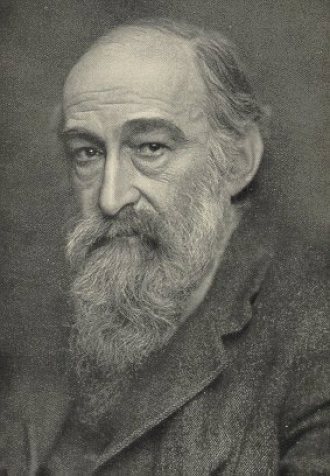
Samuel Alexander
1859–1938 · Australian-born British philosopher, exponent of emergentism and space-time metaphysics
Samuel Alexander (Sydney, 1859 – Manchester, 1938) was a philosopher born in Australia who spent almost his entire career in Britain. He belonged to the British idealist tradition of the late nineteenth century and, above all, to the realist and emergentist currents of the early twentieth. He was the first Jewish fellow of an Oxford or Cambridge college, and his major book, Space, Time, and Deity, remains one of the most ambitious attempts at systematic metaphysics in English.
He was born in Sydney into a prosperous Jewish family; his father, a saddler, died around the time of his birth. After a childhood in Victoria he studied at the University of Melbourne but left without a degree. In 1877 he went to England, won a scholarship to Balliol College, Oxford, and later became philosophy tutor at Lincoln College. In those years he took up psychology, then a neglected subject, and worked in Germany. Deafness was a constant handicap, and it took him several attempts to secure a chair, which he finally obtained at Owens College, Manchester, in 1893.
His first major book, Moral Order and Progress (1889), grew out of a prize essay and shows the influence of T. H. Green, from whose views he later diverged in favour of an evolutionary approach. His systematic achievement came with the Gifford Lectures, published as Space, Time, and Deity (1920). There he argued that space and time are inseparable and that matter and qualities arise from a process of motion. He developed the idea of emergent qualities, inspired by C. Lloyd Morgan, in which novelty appears at higher levels of complexity without being reducible to what lies beneath. On the mind, he held that an object is before consciousness without being inside it, and that contemplation can be enjoyed but not itself contemplated as an object.
His influence was considerable. He shaped the thinking of A. N. Whitehead, earned the admiration of R. G. Collingwood, and mentored figures such as John Anderson. He received the Order of Merit in 1930, the first conferred on a native of Australia, and his emergentism still figures in debates about the relation between mind, life and matter.
Key ideas
- Space-time as foundation: space and time cannot be conceived apart, and everything that exists emerges from their unity.
- Emergent qualities: new properties appear at higher levels of complexity and cannot be reduced to their parts.
- Primitive motion: motion comes before space and time, which are defined through relations between motions.
- Mind and object: an object is before the mind without being within it, and contemplation can be enjoyed but not itself contemplated.
- Emergent evolution: the evolution of nature produces successive levels of reality, from matter to life and mind.
Curiosities
First Jewish fellow at Oxbridge
He was the first Jewish fellow of an Oxford or Cambridge college, a distinction that marked his academic career.
Order of Merit
In 1930 he received the Order of Merit, the first conferred on a native of Australia.
Teachers and influences
Influenced by
- G. E. Moore 1873–1958
- Thomas Hill Green 1836–1882
- C. Lloyd Morgan 1852–1936
Influenced
- John Anderson 1893–1962
Original Filopedia text based on Wikipedia (es) and Wikipedia (en) and Wikidata.