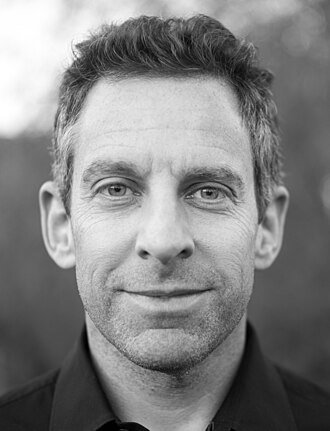
Sam Harris
b. 1967 · American neuroscientist and philosopher, a leading figure of New Atheism
Sam Harris (born in Los Angeles in 1967) is an American neuroscientist and philosopher, and one of the best-known voices of the New Atheism movement. Together with Richard Dawkins, Christopher Hitchens and Daniel Dennett, he is often grouped as one of the Four Horsemen of New Atheism. His importance lies in bringing into public debate a question many found uncomfortable: whether religious beliefs should be exempt from the scrutiny we apply to any other claim.
He studied at Stanford, where he became interested in philosophy after an experience with MDMA that convinced him he might reach spiritual insights without drugs. He left the university in his second year and spent about eleven years in India and Nepal, studying meditation with Buddhist and Hindu teachers. For a few weeks in the early 1990s he was a volunteer in the security detail of the Dalai Lama. He returned to Stanford in 1997, completed a degree in philosophy in 2000, and later earned a doctorate in cognitive neuroscience at UCLA, where he used functional magnetic resonance imaging to study the neural basis of belief, disbelief and uncertainty.
His first book, The End of Faith (2004), written soon after the September 11 attacks, spent thirty-three weeks on The New York Times bestseller list and won the PEN/Martha Albrand Award for nonfiction. Letter to a Christian Nation (2006) answered the criticism it provoked. In The Moral Landscape (2010) he argued that science can help determine what promotes human well-being, and therefore help ground moral values. He later wrote Waking Up, about spirituality without religion, and launched the Making Sense podcast.
His thinking holds that religion hinders a more rigorous ethics and spirituality, and that it should be discussed as honestly as any other field. Harris avoids presenting atheism as a doctrine; for him it is simply the rejection of bad ideas. He compares contemporary religious beliefs with the myths of ancient Greece, now outdated. He has criticised Islam harshly, which he considers especially dangerous, although his critique extends to all religions. Some critics accuse him of Islamophobia, a charge he rejects. He advocates a form of conversational intolerance that demands the same reasons and evidence from believers and non-believers alike.
His influence reaches well beyond academic philosophy. His books, his debates with figures such as William Lane Craig and Rick Warren, and his frequent television appearances have made him a reference point in the English-speaking debate on religion. He has also promoted secular meditation through the Waking Up app and, since 2020, has been a member of Giving What We Can, committed to donating at least ten percent of income.
Key ideas
- Public criticism of religion: religious beliefs should be open to frank discussion, like any other field of knowledge.
- Atheism without doctrine: for Harris, atheism is not a philosophy but the rejection of bad ideas.
- Conversational intolerance: believers and non-believers alike should meet the same demands for reasons and evidence.
- Science and values: science can help determine what promotes human well-being.
- Belief and evidence: outside religion, our beliefs usually rest on evidence and experience, which dogma tends to evade.
Where to start
The End of Faith 2004
The End of Faith is an accessible, direct essay in which Harris criticizes organized religion, examines the clash between religious faith and rational thought, and addresses the intolerance linked to religious fundamentalism. It is a good starting point because it clearly lays out the core ideas of his thinking without requiring specialized background.
Next: The Moral Landscape. The Moral Landscape develops the thesis that science can and should address moral questions, extending ideas Harris had already sketched.
Works in Filopedia
Curiosities
Rejected bar mitzvah
He told Newsweek that as a child he refused to have a bar mitzvah, despite having a Jewish mother and a Quaker Christian father.
Guarding the Dalai Lama
In the early 1990s, for a few weeks, he volunteered on the security detail of the Dalai Lama.
A television-writer mother
His mother, Susan Harris, created the series Soap and The Golden Girls.
Original Filopedia text based on Wikipedia (es) and Wikipedia (en) and Wikidata.