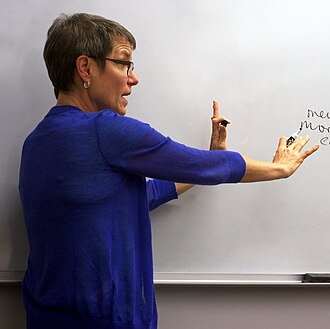
Sally Haslanger
b. 1955 · American philosopher working on metaphysics, feminist theory and social construction
Sally Haslanger is an American philosopher born in 1955 in Connecticut. She is the Ford Professor of Philosophy in the Department of Linguistics and Philosophy at the Massachusetts Institute of Technology (MIT). Working within contemporary analytic philosophy, she is best known for her work on social and political theory, feminism, and the philosophy of gender and race, areas where her ideas have had considerable influence.
She graduated from Reed College in 1977 and earned her PhD in philosophy at the University of California, Berkeley, in 1985. She has taught at Princeton, the University of Pennsylvania and the University of Michigan. In 2011 she was the Carus Lecturer of the American Philosophical Association, in 2015 she held the Spinoza Chair at the University of Amsterdam, and in 2018 she received a Guggenheim Fellowship. She co-edits Symposia on Gender, Race and Philosophy, an online publication devoted to recent work in these fields.
Her work centres on the social construction of categories often taken to be natural, especially race and gender. Her book Resisting Reality: Social Construction and Social Critique (2012), which gathers her major papers, won the American Philosophical Association's Joseph B. Gittler Award in 2014. Among her most debated proposals is an analytic definition of "woman": a person is a woman if she is systematically subordinated along some dimension and is marked for that treatment by bodily features presumed to relate to reproduction. She has since qualified or abandoned parts of this definition, notably because it marginalises trans women.
Her influence extends through feminist metaphysics and social philosophy, and her analysis of how social categories come to look like natural facts remains a reference point in debates about identity and justice.
Key ideas
- Social construction of categories: many categories, such as race and gender, that are taken to be natural are largely the product of social practices.
- Social critique: examining how these categories sustain relations of subordination and what changes would be needed to transform them.
- Analytic definition of woman: a proposal that defines gender through systematic subordination and through the way bodily features are used to mark a person as a target of that treatment.
- Persistence through change: a central theme of her metaphysical work, concerning how things and people remain the same over time.
Original Filopedia text based on Wikipedia (es) and Wikipedia (en) and Wikidata.